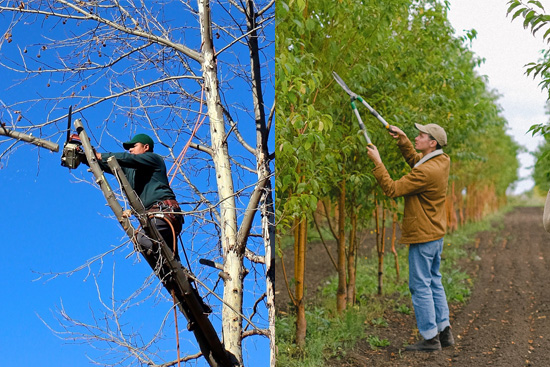
Tree trimming vs pruning is one of the most common points of confusion in tree care, and it is easy to understand why. Both involve cutting branches. Both improve the appearance of a tree. Tree service companies use the terms almost interchangeably in casual conversation, and homeowners follow their lead. But in professional arboriculture — the discipline that actually defines how trees should be cared for — trimming and pruning are distinct practices with different purposes, different techniques, different timing, and different outcomes.
Getting the distinction right matters more than it might seem. Using the wrong approach at the wrong time, or expecting one practice to deliver what the other was designed to accomplish, leads to trees that don’t improve the way the homeowner expected — and sometimes to trees that are actively set back by work that could have helped them.
Here is what each one actually means, how they differ, and how to know which one your trees need.
What Tree Trimming Actually Is
Trimming is primarily about appearance and management. It involves cutting back overgrown, extended, or misshapen branches to maintain the size, form, and clearance of a tree within its landscape context. The goal is aesthetic and spatial — keeping the tree looking intentional, preventing it from encroaching on structures, utilities, or neighboring plants, and maintaining the visual balance of the canopy.
In practice, trimming addresses branches that have grown beyond where they should be. A branch that has grown over a roofline and is brushing the shingles needs to be trimmed back for clearance. A tree that has developed a lopsided canopy after a heavy growing season needs trimming to restore visual balance. Shrubs and ornamental trees that have grown past their intended size in a formal landscape are trimmed to maintain their shape and proportion.
Trimming is typically performed during the growing season — spring and early summer — when the tree’s growth pattern is most visible and the work of keeping pace with new growth is most active. It tends to involve lighter cuts and lighter tools than pruning: hand shears, loppers, and hedge trimmers for smaller material, and the same tools on poles for reaching higher growth without climbing.
The key characteristic of trimming is that it is responding to where branches have grown, not to what is happening inside them. A branch that needs to be trimmed back is not necessarily diseased, structurally compromised, or dangerous — it has simply grown somewhere inconvenient or beyond its intended boundary.
What Tree Pruning Actually Is
Pruning is a health and structure-focused practice. It involves the selective removal of specific branches based on what is happening with the tree — not based on where branches have grown in relation to a structure or aesthetic preference, but based on the condition of the branch, its structural relationship to the rest of the tree, and what its presence or absence will mean for the tree’s long-term health and safety.
The International Society of Arboriculture defines four primary types of pruning — crown cleaning, crown thinning, crown raising, and crown reduction — each targeting a specific structural or health objective. A pruning prescription identifies which of these applies to a particular tree, and the work is executed accordingly. Cuts are made at specific locations: just outside the branch collar, at the union with a lateral branch large enough to sustain the remaining growth, or at the point that removes the compromised material while preserving the tree’s structural integrity.
This specificity of cut placement is what separates pruning from trimming most clearly. Trimming cuts branches where they have grown too long. Pruning cuts branches at the point that best serves the tree’s health, structure, and wound response — which requires understanding how trees compartmentalize wounds, how different species respond to different cut locations, and what the branch collar is and why cuts must respect it.
In Connecticut, the most important structural pruning work happens during dormancy — late fall through early spring, before new growth begins. This timing minimizes stress on the tree, reduces the risk of transmitting certain diseases through fresh pruning wounds (particularly relevant for oaks, which are susceptible to oak wilt and should not be pruned between April and July in Connecticut), and allows the tree to direct its spring energy toward healing rather than simultaneously managing new growth and wound response.
The Practical Difference: What Each One Solves
The clearest way to understand tree trimming vs pruning is to think about what problem each one is solving.
Trimming solves a spatial or aesthetic problem. A branch is in the wrong place — over a roof, across a walking path, shading a garden that needs more light, or making a formally shaped tree look uneven. Trimming moves the boundary of the canopy to where it should be.
Pruning solves a tree health or structural problem. Dead branches that could fall need to be removed. Crossing branches creating wounds at their contact points need to be addressed. A heavily weighted lateral branch developing a structural weakness needs to be reduced before it fails. A diseased section of the canopy needs to be removed before the pathogen spreads to healthy tissue. Pruning identifies these issues and removes the material that is causing or contributing to them.
A tree can need both at the same time. A large oak that has grown branches over a driveway and also has dead wood accumulating throughout the canopy needs trimming for clearance and crown cleaning — the most fundamental type of pruning — for health and safety. These are not competing approaches; they are applied to different branches for different reasons during the same service visit.
A tree can also need one and not the other. A healthy, well-structured maple that has simply grown to shade the patio needs trimming, not pruning. An old white pine with significant dead wood in the upper canopy and no clearance issues needs pruning, not trimming.
Why the Distinction Matters for Connecticut Trees
Connecticut’s tree species each respond to trimming and pruning differently, and the timing considerations that apply here are more specific than the general guidance that applies nationally.
Oaks should not have fresh pruning cuts exposed between April and the end of July, because the sap-feeding beetles that spread oak wilt are most active during this window and are attracted to fresh wounds. Pruning oak trees for structural reasons should be scheduled in late fall, winter, or very early spring. If a branch removal is necessary during the growing season due to storm damage or safety concerns, wound paint applied immediately to the cut surface reduces the risk of beetle activity.
Maples are heavy bleeders in late winter and early spring, when sap pressure is high before leaf-out. The sap flow doesn’t harm the tree, but it can be alarming to homeowners who aren’t expecting it. Dormant season pruning during deep winter — January and February in Connecticut — minimizes sap bleeding while still taking advantage of the tree’s structural clarity without leaves.
White pine and hemlock can be lightly trimmed by removing the soft new growth at the tips of branches during the spring flush — a technique sometimes called candling for pines — to slow their growth and maintain their size within a landscape. This is very different from pruning the woody older growth, which these species do not respond to as well. Removing live branches from pines during late summer or fall can create entry points for pitch canker and other fungal issues.
Dogwoods benefit from pruning immediately after flowering in spring, when the risk of dogwood anthracnose infection through fresh wounds is lower than during wet spring weather. Dead wood removal can be done any time it is identified.
Understanding these species-specific timing considerations is part of what separates professional tree care from general yard maintenance — and part of why the tree trimming vs pruning distinction is more than academic for Connecticut homeowners.
When to Call a Professional vs. When You Can Handle It
Trimming small ornamentals, hedges, and shrubs with hand tools is well within the capability of most homeowners and is a normal part of maintaining a residential landscape. Trimming branches on a mature tree that require climbing, the use of a chainsaw, or working near utility lines is not.
Pruning, in the full arboricultural sense, is almost always a professional job. Identifying which branches need to come out and which should stay, making cuts at the correct location to preserve the tree’s wound response, working safely in the canopy of a mature tree, and managing the removal of material without damaging the tree or the surrounding property all require training, equipment, and experience that go significantly beyond what a homeowner can replicate with a ladder and a hand saw.
The line is broadly this: if you can reach it from the ground or a step stool with a small pruning tool and the branch is under an inch in diameter, it is likely within scope for a homeowner. If the work requires going into the tree, using a chainsaw, working near power lines, or making structural decisions about a large mature tree, it belongs with a certified arborist.
Erick’s Tree Service has provided professional tree trimming and pruning across Connecticut for 35 years, with ISA-trained arborists who assess each tree individually before any work begins. Whether your trees need trimming for clearance and shape, structural pruning for health and safety, or both, we identify exactly what is needed and execute the work to the standard that protects both the tree and your property.
Signs Your Tree Needs Trimming vs. Signs It Needs Pruning
Your tree probably needs trimming if:
Branches are overhanging your roof, gutters, or siding. Growth is blocking sight lines at a driveway entrance or road intersection. The canopy has become uneven or lopsided after a heavy growing season. Lower branches are creating clearance problems for vehicles, foot traffic, or outdoor structures. An ornamental or formal tree has grown beyond its intended shape or boundary.
Your tree probably needs pruning if:
Dead or dying branches are visible in the canopy — look for branches with no leaves during the growing season, or branches with bark that is cracking, peeling, or missing. Branches are crossing and rubbing against each other, creating visible wounds at the contact point. The canopy is extremely dense, blocking airflow and light to the interior. A major branch appears to be weakening at its attachment point — look for cracks, included bark, or a narrow V-shaped union rather than a rounded U-shape. The tree has experienced storm damage that left broken or partially attached branches in the canopy.
Your tree needs both if:
Any of the trimming signs apply alongside any of the pruning signs — which is common in mature trees that have been growing without a regular care schedule.
If you are not sure which category your trees fall into, a professional assessment removes the guesswork. Our arborist consultation service evaluates the condition and structure of your trees and provides a clear recommendation before any work begins.
For trees that have experienced storm damage, our storm damage tree cleanup service addresses both the immediate safety concerns and the structural pruning needed after a weather event. For trees showing signs of disease or stress, our tree health and disease assessment identifies what is happening inside the canopy and informs the right pruning approach.
Contact Erick’s Tree Service for a free estimate on tree trimming, pruning, or a professional assessment of what your trees actually need. We serve residential and commercial properties across Connecticut.
Erick’s Tree Service — safe, reliable, and professional tree care for residential and commercial properties across Connecticut.