
Knowing how to spot pest damage on trees early is one of the most valuable skills a Connecticut homeowner can develop. The difference between catching an infestation in its first season and discovering it after two or three years of unchecked damage is often the difference between a treatable problem and a dead tree. Connecticut’s forests and residential landscapes face pressure from a growing list of invasive insects and native pests — many of which cause little visible damage above ground while destroying critical vascular and root tissue below.
This guide covers the eight most reliable early warning signs, the specific pests responsible for the most significant tree losses in Connecticut, and what to do when you find evidence of infestation before it reaches the point of no return.
Why Early Detection Matters More Than Most Homeowners Realize
Most tree pests do not announce themselves. The emerald ash borer, one of the most destructive invasive insects in North America, kills ash trees from the inside out — larvae feed on the cambium layer beneath the bark, severing the tree’s ability to transport water and nutrients, while the canopy continues to look reasonably healthy for one to two full growing seasons. By the time dieback becomes obvious, the tree is often beyond treatment.
The same delayed visibility applies to many of Connecticut’s most damaging pests. Effective management depends on finding the evidence before the damage reaches critical mass — exit holes in bark, unusual leaf patterns, frass accumulations, or subtle canopy changes that most homeowners walk past without recognizing.
A professional tree health and disease assessment provides the most reliable early detection — certified arborists are trained to identify pest evidence that is easy to miss during casual inspection. But between professional visits, knowing what to look for yourself dramatically improves your odds of catching problems in time to act.
1. Spot Pest Damage on Trees by Checking for Exit Holes in Bark
Exit holes are one of the clearest physical indicators of boring insect activity, and they are visible to any homeowner willing to look closely at the bark of their trees. Different pests leave different hole profiles — knowing which shape corresponds to which insect narrows the identification and determines the response.
The emerald ash borer leaves distinctive D-shaped exit holes approximately 3–4mm wide in the bark of ash trees — the flat side of the D aligns with the outer bark surface. Asian longhorned beetles leave perfectly round exit holes roughly 9–11mm in diameter, typically in maples, elms, and birches. Flatheaded borers leave oval or irregular holes, while native bark beetles create small, round holes often surrounded by pitch tubes or frass.
Finding exit holes means adult insects have already emerged — the larvae responsible for the actual damage completed their feeding cycle inside the tree before exiting. The infestation has been active for at least one full season. Contact an arborist immediately and request a full assessment of nearby trees of the same species, as borers rarely infest a single tree in isolation.
2. Look for Frass, Sawdust, and Pitch Tubes at the Base
Frass — the combination of insect excrement and chewed wood fiber that boring insects push out of their feeding galleries — is one of the earliest and most reliable signs to spot pest damage on trees before exit holes are visible. It appears as a fine, sawdust-like material accumulated in bark crevices, at the base of the trunk, or caught in spider webs on the lower stem.
Pitch tubes are a related indicator specific to bark beetles and certain weevils. They appear as small, cylindrical masses of resin — white, cream, or reddish-brown depending on the species — extruded through the bark at the entry point of larval galleries. A single pitch tube may be the tree’s defensive response to a single beetle. Multiple pitch tubes across the lower trunk indicate a significant infestation.
Inspect the base of all large trees on your property at least twice during the growing season — once in late May and again in late July — when most boring insects are at peak activity. Bring a flashlight and check low on the trunk and at the root flare.
3. Spot Pest Damage on Trees Through Canopy Dieback Patterns
Not all pest damage is visible at ground level. Canopy changes are often the first symptom a homeowner notices, and the pattern of dieback provides useful diagnostic information about what is causing it.
Flagging — individual branches with wilted, discolored, or dead foliage scattered throughout an otherwise healthy canopy — can indicate bark beetle activity, fungal wilt disease, or girdling damage from borers on those specific branches. Dieback progressing from the top of the canopy downward — sometimes called “top-down decline” — is a classic presentation of emerald ash borer infestation, as the insect’s feeding disrupts water movement to the highest, most vulnerable branches first.
Sudden and complete dieback of a major scaffold limb in the absence of storm damage suggests either a girdling borer infestation on that limb or an advanced vascular disease. Either way, it warrants immediate professional evaluation. Our arborist consultation service covers full canopy assessment and provides specific findings rather than general observations.
4. Check Leaf Surfaces for Feeding Damage and Unusual Patterns
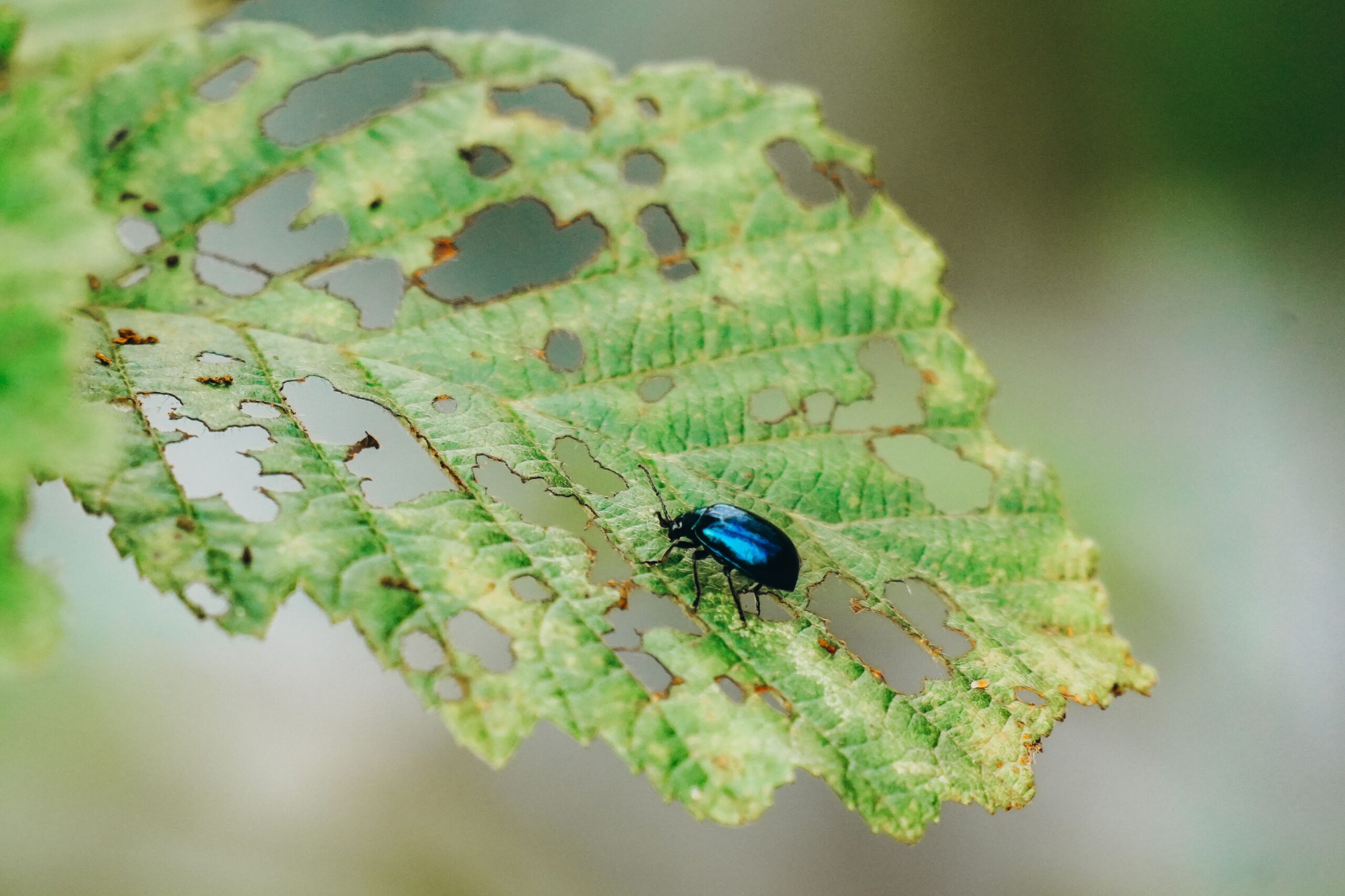
Foliar damage — the marks left on leaves by feeding insects — is one of the most visible and accessible ways to spot pest damage on trees, and it covers a wide range of insects from relatively minor nuisances to serious threats.
Skeletonizing — where feeding insects consume the soft leaf tissue between veins, leaving a transparent or papery network — is characteristic of Japanese beetle feeding on the upper canopy, as well as certain sawfly larvae on lower branches. Stippling — a fine, speckled discoloration across the leaf surface — indicates spider mite feeding, which becomes significantly more damaging during hot, dry Connecticut summers when mite populations explode.
Rolled or folded leaves with feeding damage inside indicate leafroller caterpillars. Mines — winding or blotchy trails visible through the leaf surface — indicate leafminer fly or moth larvae feeding between the upper and lower leaf surfaces. Galls — abnormal swellings or growths on leaf tissue, petioles, or stems — are caused by gall-forming insects and mites, most of which are cosmetically unpleasant but not structurally threatening.
Severe defoliation across multiple seasons — particularly relevant for Connecticut oaks targeted by spongy moth — is genuinely dangerous. A healthy tree can typically recover from one season of complete defoliation, but two or three consecutive years of severe leaf loss, especially combined with drought stress, can push a tree into irreversible decline. Deep root fertilization supports the recovery of defoliated trees by ensuring the root system has the nutrients needed to generate a second flush of growth.
5. Look for Sticky Residue and Sooty Mold on Leaves and Surfaces
Honeydew — a sticky, sugar-rich liquid excreted by sap-feeding insects — is a reliable indirect indicator of aphid, scale, or whitefly infestation. You may notice it before you see the insects themselves, because it falls from the canopy and accumulates on leaves below, on cars parked under the tree, on patio furniture, or on hard surfaces around the base.
Sooty mold — a black, powdery fungal growth — follows honeydew wherever it accumulates. The mold itself does not infect the tree, but its presence on leaf surfaces reduces photosynthesis by blocking sunlight. More importantly, honeydew and sooty mold are reliable indicators of a significant population of sap-feeding insects somewhere in the canopy above.
Inspect the undersides of leaves in the affected area carefully. Aphids cluster in dense colonies, often at the growing tips of branches. Soft scales appear as small, oval, waxy bumps attached to stems and twigs. Armored scales form flat, circular or oyster-shaped coverings on bark. All are treatable when caught early; severe infestations can cause significant dieback and branch loss if left unmanaged.
6. Spot Pest Damage on Trees by Monitoring for Unusual Woodpecker Activity
Woodpeckers are an indirect but highly reliable indicator of boring insect infestations — particularly emerald ash borer. Woodpeckers feed on EAB larvae by stripping bark from infested sections of trunk and large branches to access the feeding galleries beneath. The resulting damage — irregular patches of stripped bark exposing pale wood, often on the upper trunk and primary scaffold limbs — is sometimes called “blonding” and is one of the most visible signs of an active EAB infestation.
Unusual or concentrated woodpecker activity on a specific tree is worth treating as a diagnostic signal. If woodpeckers are repeatedly returning to the same trunk location on an ash, maple, or elm, it is almost certainly because there is larval feeding activity beneath that bark. Schedule a professional inspection rather than waiting for exit holes or canopy symptoms to confirm what the woodpeckers are already telling you.
7. Watch for Early Leaf Drop and Off-Season Foliage Loss
Premature leaf drop — leaves falling in July or August that should remain on the tree until October — is a stress signal that can indicate several problems, but pest infestation is consistently among them. Significant mite infestations, severe aphid pressure, and borer activity that disrupts water movement can all trigger early leaf drop as the tree sheds foliage it can no longer adequately supply.
Off-season foliage changes are particularly worth noting on species that have known pest vulnerabilities in Connecticut. Ash trees showing early leaf drop in midsummer should be assessed for EAB. Hemlocks dropping needles prematurely may be under attack from hemlock woolly adelgid, an invasive pest that has caused significant hemlock mortality across southern Connecticut. Any evergreen showing abnormal needle browning or drop outside of normal seasonal patterns warrants professional evaluation.
Our tree health and disease assessment covers species-specific pest risks and provides a documented condition report — useful both for planning treatment and for maintaining records if the tree needs to be addressed under a municipal tree ordinance.
8. Inspect the Root Zone and Bark at Ground Level Seasonally
The root zone and lower trunk are where some of the most damaging pest activity originates — and where it is most consistently overlooked. Root-feeding beetles, crown borers, and certain weevil species attack trees at or just below the soil line, where damage is hidden and symptoms in the canopy may not appear for an entire season after the infestation begins.
Get close to the base of your trees at least twice a year. Look for entry wounds in the bark at the root flare, fine frass mixed into the soil around the base, soft or spongy bark at ground level, and any unusual fungal growth emerging from the soil near the trunk. These are indicators of root and crown borers that will not show up in a casual canopy inspection.
For trees with suspected root zone pest activity, a professional arborist consultation is the appropriate next step. Treatment options — systemic insecticide applications, soil drenches, or trunk injections — depend on accurate species identification, which requires hands-on professional assessment.
Connecticut’s Most Damaging Tree Pests in 2026
Understanding the specific threats active in Connecticut helps prioritize what to watch for on your property.
Emerald Ash Borer (EAB): Now present throughout Connecticut. All native ash species are susceptible. Treatment is available for trees with less than 50% canopy dieback; beyond that threshold, tree removal and replacement is typically the recommended path.
Spotted Lanternfly: Range expanding across Connecticut. Primarily targets tree of heaven but feeds on a wide host range including maple, oak, walnut, and fruit trees. Egg masses — grey, putty-like rectangular deposits on bark and hard surfaces — are the most reliably detectable early sign.
Hemlock Woolly Adelgid: Active across southern and central Connecticut. Look for white, cottony egg sacs attached to the undersides of hemlock needles at the base of individual needles. Untreated infestations are fatal to eastern hemlock within 4–10 years.
Spongy Moth (formerly Gypsy Moth): Cyclical defoliation pressure on oaks, aspen, and birch. Population levels vary by year; egg mass counts in fall predict the following season’s pressure.
Asian Longhorned Beetle: Not yet established across Connecticut but subject to active monitoring. Report any suspected sightings to the Connecticut DEEP immediately — early reporting is the primary defense against establishment.
If you have found evidence of pest activity on your property — or if you want a baseline assessment before problems develop — the most effective next step is a professional inspection. Early intervention is consistently less expensive, more effective, and less disruptive than addressing infestations after they have progressed.
Contact Erick’s Tree Service to schedule a tree health assessment, or learn more about our tree trimming and pruning and hazardous tree removal services across Connecticut.
Erick’s Tree Service — safe, reliable, and professional tree care for residential and commercial properties across Connecticut.