
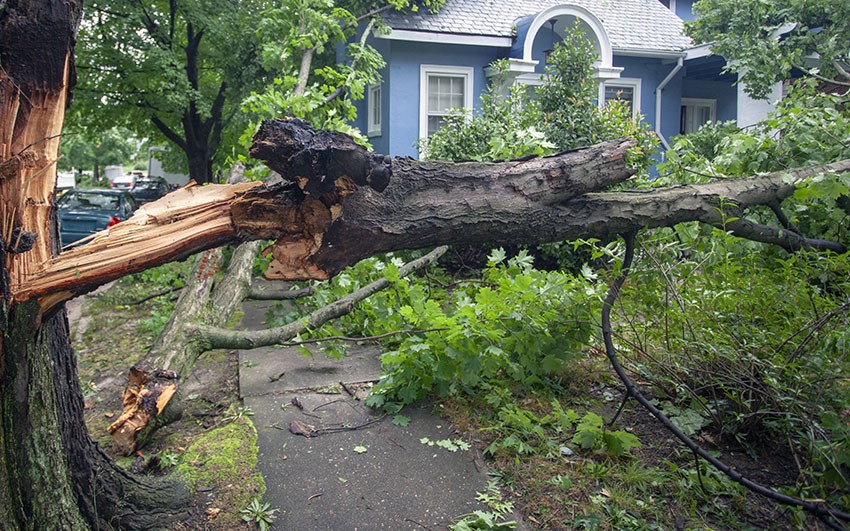
Fallen tree removal is one of those situations homeowners are never fully prepared for, even in a state like Connecticut where nor’easters, summer thunderstorms, tropical remnants, and early-season ice storms make tree failures a regular reality. A tree comes down in the middle of the night. It lands on the roof. It blocks the driveway. It takes down a section of fence and is leaning against the neighbor’s garage. The immediate question is always the same: who do you call, and what do you do right now?
The answer depends on the specific situation — whether there is a structural threat, whether power lines are involved, whether the tree is on your property or someone else’s. Getting the sequence right protects you, your family, and your property. Getting it wrong — particularly by attempting to handle a fallen tree situation yourself — puts you at serious risk.
Here is the complete, practical guide to what to do when a tree goes down in Connecticut.
Step One: Assess the Immediate Safety Situation
Before any phone calls, before any photos, before anything else — establish whether the situation is immediately dangerous and act accordingly.
A fallen tree is not a stable object. Even after it has come to rest, it can shift, roll, and drop additional sections without warning. The root ball of a recently uprooted tree is under enormous tension and can swing violently if the trunk is cut or moved. Branches that are partly broken but still attached — called widow-makers — can drop at any moment. A tree that has fallen partially onto a structure may have caused damage that makes the building unsafe to enter or remain in.
The most important rule is also the simplest: if you are not certain the situation is safe, treat it as unsafe and act accordingly. Leave the building if the tree has hit a structure. Stay well clear of the fallen trunk and canopy. Keep children and pets inside or away from the area. Do not attempt to cut, move, or pull any part of the tree until a professional has assessed the situation.
If anyone has been injured, call 911 immediately before anything else.
Step Two: Check for Downed Power Lines
This is the most critical safety check after a tree falls, and it is non-negotiable. If the tree has brought down power lines — or if you are not certain whether any lines in the area are active — treat every wire as live until a utility company confirms otherwise.
Downed power lines can energize the ground, the fallen tree, any metal fencing or guttering the tree has contacted, and standing water in the area. The danger zone extends well beyond the wire itself. Stay at least thirty feet from any downed line and keep others away.
If power lines are down, call your utility company immediately. In Connecticut, Eversource Energy serves the majority of the state. United Illuminating serves portions of Fairfield and New Haven counties. Your utility provider has 24-hour emergency lines specifically for downed wire reports and will dispatch crews to de-energize the line before anyone can safely work on or near the fallen tree.
Do not call a tree service and ask them to begin fallen tree removal work near downed power lines. Responsible tree companies will not work in proximity to energized lines, and a company that agrees to do so is not one you want near your property.
Step Three: Call a Professional Tree Service for Fallen Tree Removal
Once you have established that the immediate situation is safe — or once utility crews have addressed any power line concerns — your next call is to a professional tree service with emergency response capability.
Fallen tree removal is not a do-it-yourself job under any circumstances. Connecticut tree service professionals consistently emphasize that fallen trees are under far more stress than they appear. When a large tree falls, the wood under the trunk and major branches is under compression while the wood on top is under tension. Cutting a section of trunk or a large branch releases that stress in ways that are violent and unpredictable — trunk sections can roll, branches can spring sideways, and pieces can launch in unexpected directions. Professional arborists are trained specifically to read these forces and sequence their cuts to release tension safely. Untrained homeowners attempting the same work with a chainsaw face serious injury risk.
The specific professionals to call depend on the nature of the fallen tree situation:
For a tree that has fallen on a structure — your home, a garage, a fence, or any occupied building — call a tree service with emergency structural experience immediately. The tree needs to be removed in a controlled sequence that protects the structure beneath it from additional damage as the weight is released. This is specialized work that requires rigging, cranes in many cases, and arborists who understand how to manage the loads involved. Erick’s Tree Service provides emergency tree removal and fallen tree removal across Connecticut, with the equipment and experience to handle structural situations safely.
For a tree that has fallen in the yard, on the driveway, or across a fence — this is still professional work, but the urgency is lower. The tree is contained, not threatening to cause additional structural damage, and the situation can typically be scheduled rather than requiring an immediate after-hours response. That said, a partially fallen tree or one that is leaning against another structure can shift, so prompt scheduling is still advisable.
For a tree that has fallen across a road — this is a public safety matter. Call your town’s public works department or, if it is a state road, the Connecticut Department of Transportation. Municipal arborists and road crews handle tree clearance on public roads. Do not attempt to move a tree from a road yourself.
Step Four: Call Your Insurance Company
As soon as the immediate safety situation is managed and professional tree removal is underway or scheduled, contact your homeowner’s insurance company to report the incident.
Whether insurance covers fallen tree removal and any structural damage depends on your specific policy and the circumstances of the fall. Most standard homeowner’s insurance policies cover damage to structures caused by a fallen tree — the cost of repairing a roof, a fence, or a car, for example — but may not cover the cost of removing the tree itself if it fell in the yard without hitting anything. Policies vary significantly, and speaking to your insurer early ensures you understand what is and is not covered before you authorize work.
Document the scene thoroughly with photographs before any removal work begins — or as soon as it is safe to do so. Photograph the fallen tree, the point of impact on any structure, the surrounding area, and the damage from multiple angles. These photos are the primary evidence for your insurance claim and should be taken before anything is moved or cleaned up.
Your insurance company may send an adjuster before authorizing repairs. Coordinate with your tree service to understand the timeline, and get a written estimate from the tree service before work begins — this documentation is typically required as part of the claims process.
Step Five: Address the Stump and Cleanup
After the main fallen tree removal is complete, two additional items typically remain: the stump and the debris.
The stump left by a fallen tree is an ongoing issue if left in place. It can harbor disease and wood-boring insects that affect neighboring trees, it creates a tripping hazard, and it prevents replanting or lawn restoration in the affected area. Stump grinding reduces the stump to wood chips below grade, allowing the area to be lopped, replanted, or restored. The wood chips can be used as mulch or removed from the site depending on preference.
Brush, branches, and wood from the fallen tree can be handled in several ways. Wood chipping processes the smaller material into chips on site. Larger sections of trunk can be left as firewood if the species is suitable and the homeowner has use for it, or hauled away as part of the overall removal scope. Erick’s Tree Service handles complete brush and debris removal as part of fallen tree cleanup, leaving the site clean rather than simply removing the main trunk sections.
Who Is Responsible When a Neighbor’s Tree Falls on Your Property?
This is one of the most common questions Connecticut homeowners ask after a fallen tree incident, and the answer is not always what people expect.
In general, if a tree falls onto your property and causes damage, your own homeowner’s insurance is the primary resource for covering that damage — regardless of where the tree originated. The owner of the tree that fell may be liable if the tree was visibly dead, diseased, or hazardous and the owner had been notified of the risk and failed to address it. Liability is harder to establish for a healthy tree that fell due to storm forces or without prior warning.
Connecticut statute 52-560 covers trees on private property and neighbor disputes. For trees along public roads, CT statute 23-58 establishes that every municipality is required to have a town tree warden responsible for municipal tree management. If a town-owned tree falls and causes damage to your property, the tree warden’s office is the starting point for understanding the municipality’s responsibility.
For questions about neighbor liability and insurance coverage after a fallen tree incident, consult your homeowner’s insurance company and, if the situation is disputed, a property attorney. The immediate priority — getting the tree safely removed and the damage documented — can proceed while the liability question is being addressed separately.
What to Do If the Tree Is Still Standing but Clearly Hazardous
A fallen tree that has already come down is an emergency. A tree that has not yet fallen but shows clear signs of being about to — severe lean that appeared suddenly, significant root lift, major crown breakage exposing the root plate, or significant bark damage at the base — is a preventable emergency.
If you notice a tree on your property that appears unstable, the first call is to a professional arborist for a hazard assessment. Removing or stabilizing a tree before it falls is significantly less complicated and less expensive than fallen tree removal after the fact — and the risk of structural damage or personal injury is eliminated.
Erick’s Tree Service provides arborist consultations and hazardous tree removal for Connecticut homeowners concerned about trees that show warning signs before they fail. We also offer storm preparation tree assessment before major weather events — an evaluation of the trees most likely to fail during a storm, giving homeowners the information to act before the storm rather than clean up afterward.
If you are dealing with a fallen tree right now or need to schedule fallen tree removal and cleanup anywhere in Connecticut, contact Erick’s Tree Service for a prompt response. We provide emergency and non-emergency fallen tree removal, stump grinding, brush cleanup, and complete storm damage tree cleanup for residential and commercial properties across the state.
Erick’s Tree Service — safe, reliable, and professional tree care for residential and commercial properties across Connecticut.