Yes — trees can significantly affect home insurance claims, both in your favor and against you, and the deciding factor is almost always whether the tree was healthy and cared for or dead and neglected. For Connecticut homeowners, where nor’easters, ice storms, and summer windstorms regularly bring branches and whole trees down, understanding how trees and insurance interact can be the difference between a covered loss and a denied claim. Here are five things every homeowner should know — with the reminder that every policy is different, so you should always confirm the specifics with your own insurer.
Fact 1: When Home Insurance Typically Covers Tree Damage
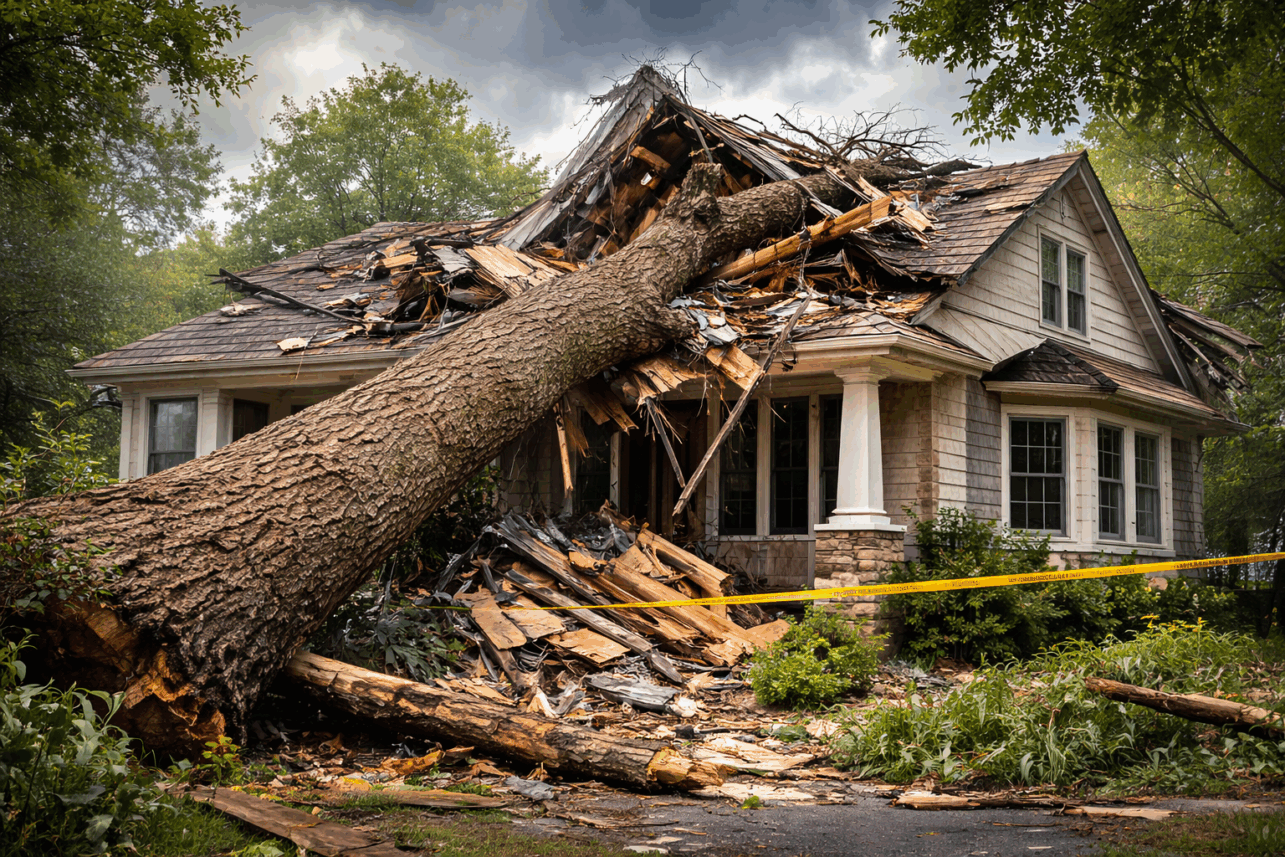
In general, standard homeowners policies in the U.S. cover tree damage when it results from a sudden, accidental, covered event — a storm blowing a tree onto your roof, wind snapping a limb onto your garage, the weight of ice bringing a tree down on your fence. In those cases, most policies help pay to repair the covered structure the tree damaged, and often to remove the tree from that structure.
The key word is sudden. Insurance is built to cover unexpected events, not predictable ones. When a healthy tree fails in a storm, that’s the kind of loss coverage exists for. This is also why prompt storm damage tree cleanup and documentation right after an event matter so much for home insurance claims.
Fact 2: Why Home Insurance Claims Get Denied — Negligence
Here is where homeowners get caught out. If a tree that falls was already dead, diseased, or visibly hazardous, an insurer can argue the damage was preventable — and preventable damage is frequently excluded. Many denied home insurance claims come down to this single point: the homeowner knew, or reasonably should have known, that the tree was a risk and did nothing about it.
That’s a costly position to be in. A dead tree leaning toward your house isn’t an accident waiting to happen in the insurer’s eyes — it’s a maintenance issue you were responsible for. Scheduling dead tree removal or hazardous tree removal before a storm doesn’t just protect your property; it removes the exact argument insurers use to reject home insurance claims.
Fact 3: What Home Insurance Usually Does Not Cover
Coverage has limits worth knowing before you need them. In many policies, if a tree falls but doesn’t hit a covered structure — it just lands in your yard — removal of that tree may not be covered at all, or only up to a small capped amount. The value of the tree itself is typically not reimbursed either; insurance covers the structures a tree damages, not the plant you lost.
Deductibles apply as well, so a minor incident may cost less than your deductible and not be worth claiming. And a tree that falls for reasons unrelated to a covered peril may fall outside coverage entirely. Because these details vary so much from one policy to the next, reviewing your own coverage — and asking your insurer directly about tree scenarios — is the only way to know where you actually stand.
Fact 4: Documentation and Tree Care Strengthen Your Claim
When it comes to home insurance claims, proof is everything. Homeowners who can show that their trees were regularly inspected and maintained are in a far stronger position than those who can’t. Records of professional care — inspection dates, a tree health and disease assessment, pruning invoices, an arborist’s report — demonstrate that you acted responsibly, which directly counters any suggestion of negligence.
A pre-season storm preparation tree assessment is especially valuable here. It creates a documented, professional record that your trees were sound before a storm hit — powerful support if you ever need to file, and useful evidence that any failure was genuinely sudden rather than foreseeable.
Fact 5: Liability When Your Tree Falls on a Neighbor’s Property
Trees don’t respect property lines, and this is where things get delicate. Generally, if your healthy tree falls onto a neighbor’s home during a storm, their insurance handles their damage. But if your neglected tree does — one you were warned about or that was obviously dead — you could be held liable, and your neighbor’s insurer may come after you to recover their costs. The same logic that governs your own home insurance claims applies across the fence: documented care protects you, and neglect exposes you. When in doubt about a questionable tree near a boundary, an arborist consultation is a small cost that can prevent a large liability.
How Proactive Tree Care Protects Your Claim and Your Property
The through-line across all five facts is simple: insurers reward homeowners who maintain their trees and penalize those who don’t. Proactive care — removing dead and hazardous trees, keeping the rest healthy and well-pruned, and documenting the work — is the single best thing you can do to keep home insurance claims on your side. It also, of course, reduces the odds you’ll ever need to file one.
None of this replaces a conversation with your insurance provider, who can tell you exactly what your policy covers. But the tree side of the equation is entirely within your control.
Protect Your Home and Your Coverage With Erick’s Tree Service
A healthy, maintained tree is an asset your insurer respects; a neglected one is a liability that can cost you a claim. Erick’s Tree Service helps Connecticut homeowners stay on the right side of that line with professional inspections, hazardous and dead tree removal, storm preparation, and rapid emergency tree removal when the weather turns.
If you have a tree you’re worried about — or just want a documented assessment before storm season — contact us or call (203) 514-4967 for a free inspection with no call-out fee.
Erick’s Tree Service — safe, reliable, professional tree removal, trimming, stump grinding, and emergency storm cleanup for residential and commercial properties in Connecticut. This article is general information and not insurance or legal advice.