Tree pollarding is a pruning method in which a tree is cut back to the same set of points year after year, forming a permanent framework of branches that produces a dense flush of new growth each season. It is one of the oldest managed pruning systems in the world, used for centuries across Europe to control a tree’s size, shape, and height while keeping it healthy and productive. Done correctly, pollarding keeps a large-growing species contained in a small space for decades. Done incorrectly — or confused with tree topping — it can permanently damage a tree.
Here is what every Connecticut property owner should understand before considering it.
How Tree Pollarding Actually Works
The process begins when a tree is still young. Once the trunk and main branches reach the desired height, the branches are cut back to short stubs, establishing the framework the tree will keep for the rest of its life. From that point on, the new shoots that grow each year are removed on a regular cycle — anywhere from once a year to once every several years, depending on the species and the goal — always cutting back to the same points.
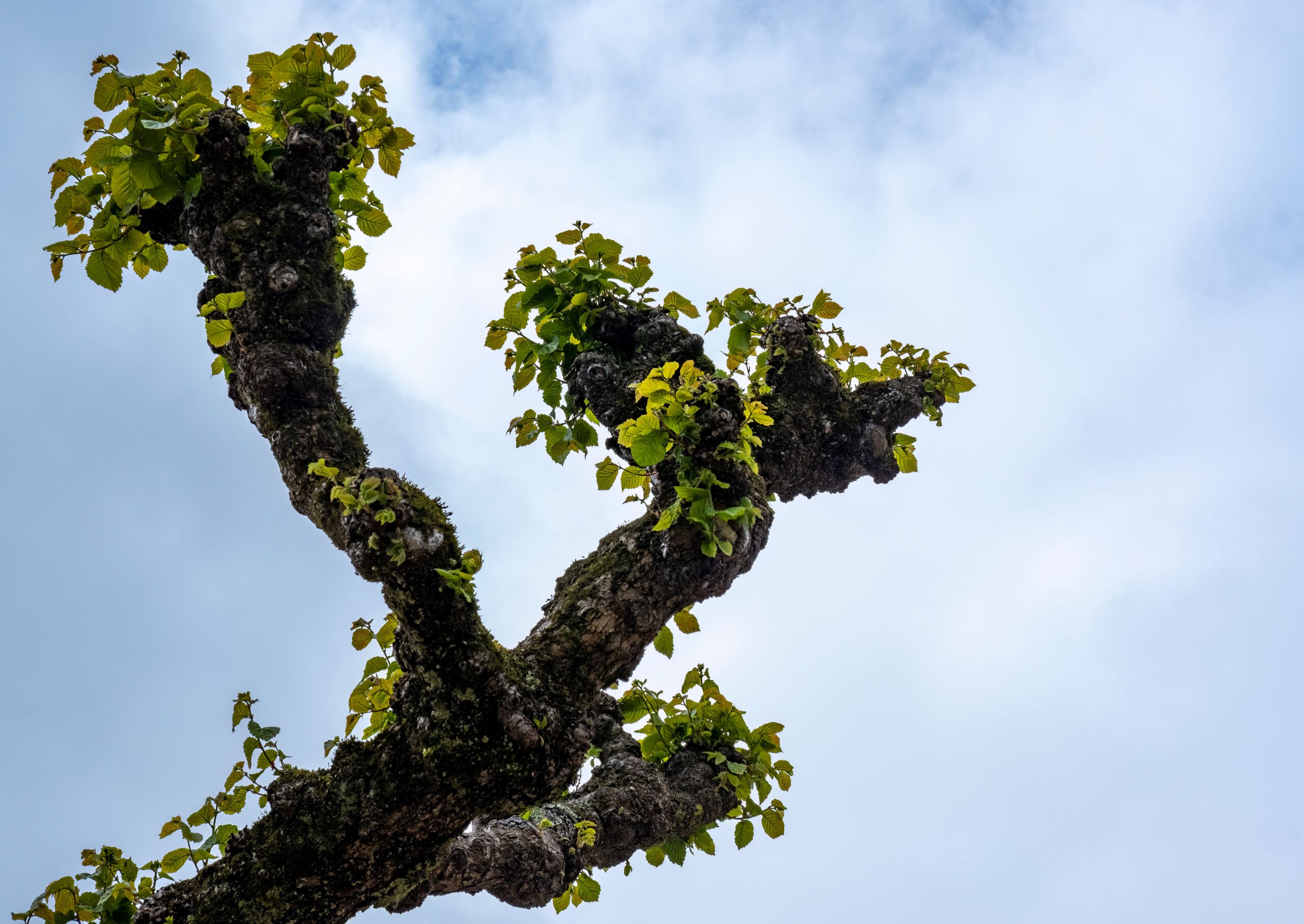
Over time, those cut points swell into knobby, callused masses called pollard heads or knuckles. The tree responds to each pruning by sending out vigorous new shoots, which is exactly the point: pollarding harnesses the tree’s natural regrowth to create a controlled, renewable canopy on a permanent frame.
How Tree Pollarding Differs From Topping
This is the single most important distinction, because the two are constantly confused — and one is a legitimate technique while the other is arboricultural damage.
Topping is the indiscriminate cutting of mature branches back to stubs, usually to reduce a tree’s height quickly. It leaves large wounds the tree cannot seal, triggers weak, poorly attached regrowth, invites decay, and shortens the tree’s life. It is widely condemned by arborists.
Tree pollarding, by contrast, is a deliberate system started on a young tree and maintained on a consistent schedule. The cuts are made at the same points every cycle, the wounds stay small, and the tree forms healthy callus heads it can defend. The difference is not the appearance of a freshly cut tree — both can look stark — but the plan behind it. Pollarding is a lifelong commitment made early; topping is a shortcut taken late. If you’re unsure which your tree needs, an arborist consultation will tell you honestly whether pollarding is even appropriate.
Why Property Owners Choose Tree Pollarding
There are several practical reasons this method has survived for so long. Size control is the main one: pollarding lets you keep a species that would naturally reach 60 feet at a manageable 15 or 20, which is invaluable near buildings, sidewalks, driveways, and overhead utility lines. It also creates a formal, uniform look prized in avenues, courtyards, and structured landscapes.
Beyond aesthetics, pollarding can improve safety by keeping heavy limbs from developing over structures, and it can extend the functional life of certain trees by continually renewing young, vigorous wood. Historically, the same technique was used to produce a steady supply of firewood and animal fodder without killing the tree — a renewable harvest from a permanent trunk.
The Best Trees for Pollarding
Not every tree tolerates this treatment, and choosing the wrong species is a costly mistake. Pollarding works only on trees that readily resprout from old wood. Species that respond well include London plane, linden (lime), many willows and poplars, mulberry, catalpa, and certain maples and oaks. These trees have the vigor and biology to handle repeated hard pruning.
Most conifers — pines, spruces, firs — do not tolerate it at all, because they generally cannot regenerate from bare old wood. Cutting them back this way simply kills the branch. A professional tree health and disease assessment confirms whether a specific tree is a suitable, healthy candidate before any cuts are made.
Timing and the Long-Term Commitment
Tree pollarding is done during dormancy, typically in late winter to early spring before the tree leafs out. Dormant-season cuts minimize stress and let the tree channel its stored energy into strong spring regrowth.
The commitment is the part homeowners underestimate. Once a tree is pollarded, it must be maintained on schedule for the rest of its life. Skipping cycles allows the new shoots to grow large and heavy on the pollard heads, where they are weakly attached and prone to failure — and at that point you cannot simply “let it grow out” into a natural form without risk. This is why pollarding is a decision to make deliberately, with a maintenance plan and a professional tree trimming and pruning partner in place from the start.
When Tree Pollarding Is the Wrong Choice
For most Connecticut yard trees, it isn’t the right answer. A mature tree that has never been pollarded should not be started on the system late in life — that crosses into topping, with all its damage. And a tree that simply has a few problem limbs or needs shaping is far better served by ordinary structural pruning than by a lifelong pollarding cycle.
Pollarding is a specialized tool for specific situations: formal designs, tight urban spaces, utility conflicts, and species that thrive under it. Often the better path for a homeowner is well-timed maintenance pruning — and if a tree has outgrown its space beyond what pruning can fix, thoughtful tree removal and replanting with a more appropriately sized species is more sensible than committing to decades of pollarding. If you’d like to understand who should be doing this kind of work in the first place, our guide on tree surgeon vs arborist is a useful read.
Talk to Erick’s Tree Service Before You Pollard
Tree pollarding, done properly, is a precise, long-term system — not a one-time trim, and never a substitute for topping. Whether it’s the right choice for your property depends on the species, the tree’s age and health, and your willingness to maintain it on a cycle. That’s a judgment best made with a trained arborist, not a chainsaw and a guess.
Erick’s Tree Service provides expert tree care for residential and commercial properties across Connecticut, from specialized pruning to health assessments and safe removals. To find out whether tree pollarding suits your trees — or what the smarter alternative might be — contact us or call (203) 367-8219 for a free inspection with no call-out fee.
Erick’s Tree Service — safe, reliable, professional tree removal, trimming, stump grinding, and emergency storm cleanup for residential and commercial properties in Connecticut.