
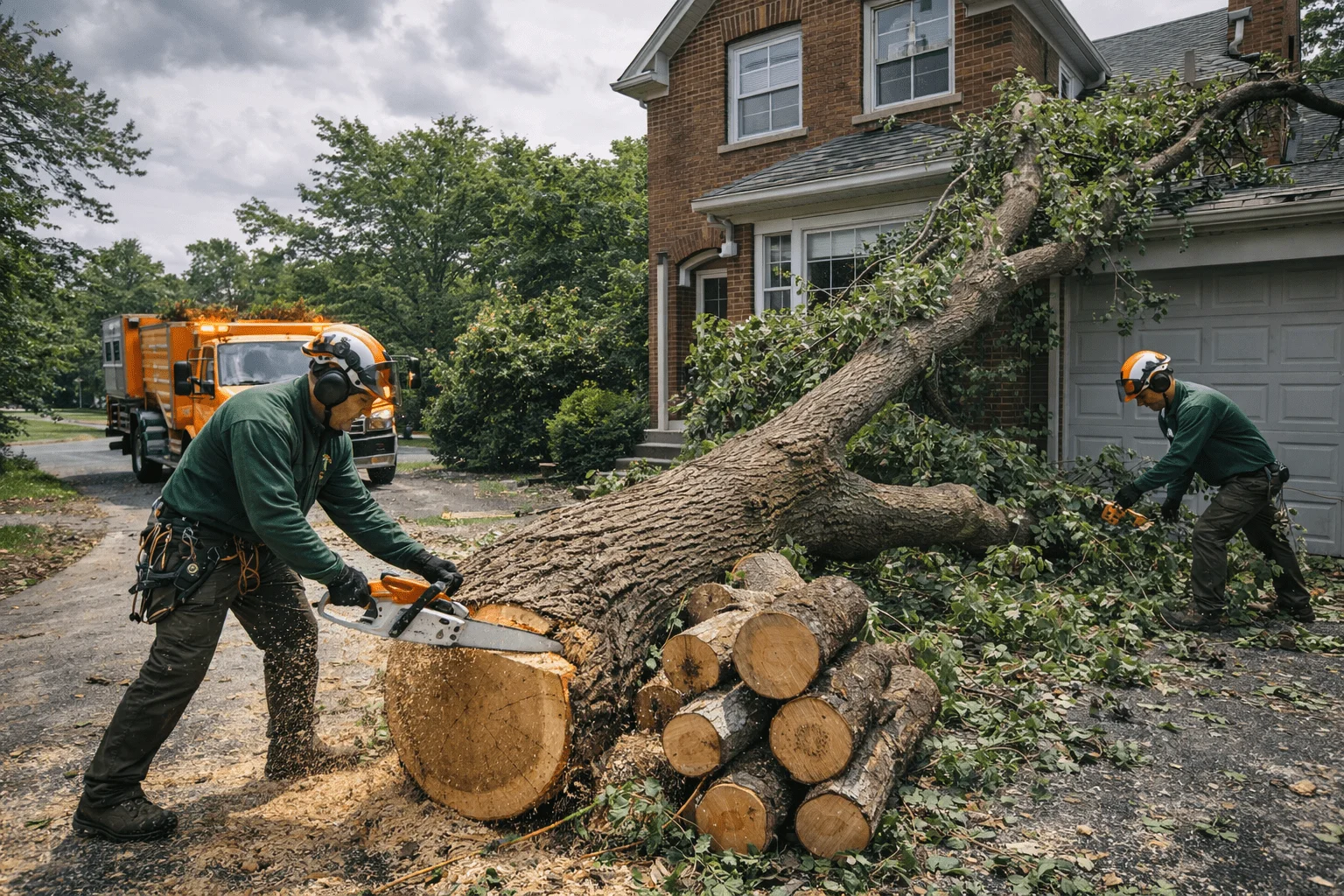
Connecticut storms do not give much warning and they do not negotiate. Nor’easters, summer microbursts, late-season tropical remnants, and ice storms arrive on their own schedules and leave behind whatever they leave behind — trees on roofs, trees across driveways, trees tangled in power lines, and an urgent question about what to do next. Emergency tree removal in Connecticut follows a specific sequence that most homeowners have never thought through until the moment they need it, and the decisions made in the first hour after a storm significantly affect both the safety of the situation and the eventual insurance outcome.
This is what to do, in order, when a storm has brought a tree down on your Connecticut property.
Step 1: Do Not Go Outside Until the Storm Has Fully Passed
This sounds obvious. It is not always followed. During and immediately after a storm — particularly during the lull in the middle of a nor’easter or between squall lines — the urge to assess damage is strong. Resist it.
Falling branches, unstable trees that are partially uprooted but still standing, and trees whose structural failure has been initiated but not completed are all active hazards that do not announce their final movement before it happens. A tree that appears to have landed and stabilized can shift, roll, or drop additional material without warning as tension in the wood and the remaining root system redistributes. Stay inside until conditions are fully calm and sustained.
Step 2: Call 911 If Anyone Is Injured or Trapped
This step has no competitors. If anyone has been injured by a falling tree or is trapped under fallen material, emergency services are the first call — before tree removal, before insurance, before photography.
Step 3: Check for Downed Power Lines Before Going Outside
Before stepping outside for any reason, look carefully at the area around any fallen tree for contact with power lines. This is the most critical safety check in any storm tree situation.
Downed lines are not always visibly arcing or sparking. They may appear dead but remain energized. A tree in contact with an energized line transmits current through its trunk and along the ground — the danger zone extends at least 30 feet from the wire in all directions. Water pooling near a downed line can carry current further. Ground current from an energized downed line can incapacitate or kill without direct contact with the wire.
If lines are down or potentially in contact with the fallen tree:
- Do not approach the tree under any circumstances
- Keep others away from the area
- Call Eversource Energy (if in their service area) or United Illuminating immediately — both maintain 24-hour emergency lines for downed wire reports
- Do not call a tree service and ask them to begin work near downed lines. Any reputable tree company will decline.
Utility crews must de-energize and clear the lines before any tree removal work can proceed safely.
Step 4: Document Everything Before Anything Is Moved
Once it is safe to be outside and any utility emergency is being handled, documentation is the next priority — before any removal work begins, before any emergency tarping, and before any part of the tree is moved.
Comprehensive photograph and video documentation of the scene is the foundation of an insurance claim. Photograph the fallen tree from multiple angles. Photograph the full contact point where the tree meets any structure — roof, wall, fence, vehicle — from multiple angles and distances. Document the surrounding property. Photograph any visible damage to structures, including interior damage visible through windows or openings.
This documentation is what your insurance adjuster will need and what supports the value of your claim. Documentation taken after cleanup has begun is less useful. Documentation that captures the scene exactly as the storm left it is the most powerful evidence you have.
Step 5: Call Your Insurance Company
The sequence here matters: document first, then call your insurer — not because the call can wait indefinitely, but because you want to be able to describe the situation accurately and confirm that you have documentation ready before any work begins.
In Connecticut, homeowner’s insurance typically covers tree removal costs when the tree has damaged a covered structure — your home, an attached garage, a detached structure listed in the policy. If a tree has fallen in the yard without contacting a structure, coverage for removal costs varies by policy. Most standard policies do not cover the cost of removing a tree that fell in the yard but caused no structural damage, though some policies and riders provide this coverage.
Key things to confirm with your insurer before work begins:
Whether a claims adjuster needs to visit before removal proceeds or whether documented photographs are sufficient to start the claim. Whether there is a preferred or approved contractor requirement for storm damage work under your policy. What the policy’s deductible is and how it applies to tree removal versus structural repair costs. Whether emergency protective measures — tarping a damaged roof, for example — are covered as additional living expense or under the damage claim.
Getting clear answers to these questions before the tree service begins work can prevent disagreements about coverage after the fact.
Step 6: Call a Professional Tree Service — and Why DIY Is Not an Option
Storm-damaged trees are the most dangerous category of tree work that exists. This is not a general warning about the hazards of chainsaw use. It is a specific description of the physics of a storm-damaged tree.
When a tree falls, the forces that were distributed across its structure — the weight of the crown, the tension in the wood, the compressive force in the trunk, the root plate tension — do not resolve when the tree hits the ground. They redistribute. The wood is under enormous stored stress, and cutting into that wood releases that stress in ways that are violent and unpredictable to anyone who has not been trained specifically in the sequence of cuts that manage those forces safely.
Fallen trees can roll when sections of trunk are cut — rotating toward anyone standing nearby. Branches that appear to be resting can spring sideways or upward when the load above them is cut. Sections of tree that appeared stable can drop suddenly when adjacent material is removed and the load redistribution shifts. These are not rare events — they are documented, consistent behaviors of storm-damaged wood that professional arborists train specifically to anticipate and manage.
Erick’s Tree Service provides emergency tree removal in Connecticut for exactly these situations. Our team responds promptly after major storm events, brings the rigging, crane capacity, and technical training to remove damaged trees safely from structures and other sensitive positions, and works with documented assessment at every stage to support insurance claims.
Step 7: What the Emergency Removal Actually Involves
Understanding what professional emergency tree removal involves helps homeowners know what to expect and how to prepare for the crew’s arrival.
Access. Tree removal equipment — including bucket trucks and cranes for roof situations — needs clear access to the site. Clear your driveway of vehicles, move any easily relocated obstacles, and identify where the crew should park and stage their equipment before they arrive.
Sequencing from the top. A tree that has fallen on a structure is removed from the top down, with each section rigged and controlled before the cut is made. The crew does not simply cut the trunk into sections from one end — they work in a sequence that manages the load at each stage to prevent additional damage to the structure beneath the tree. For roof situations, crane-assisted removal is often the safest and most structure-protective approach, because it allows full sections to be lifted vertically off the roof rather than dragged.
Assessment of the remaining canopy. The tree that fell in the storm is not always the only problem. A storm powerful enough to topple or break one tree has likely stressed other trees on the property — splitting unions, breaking branches that are now hanging in the canopy, or initiating root plate failure that has not yet resulted in a complete fall. A professional crew that is on site for the emergency removal should be asked to assess the condition of the other trees on the property while they are there. This is exactly what storm damage tree cleanup involves — not just the immediate fallen material but the assessment of what remains.
Cleanup scope. Emergency removal in most situations addresses the primary fallen material — the trunk sections, the major branches — and clears the structure. Complete cleanup of smaller branches, chips, and debris is typically a separate scope that follows the emergency work and can be scheduled for the following day or days when the immediate safety situation has been resolved.
Step 8: Assess the Rest of the Property
Once the immediate emergency is managed, a systematic walk of the property is the next step — looking specifically for the secondary damage that storm events frequently produce alongside the obvious primary failure.
Look for branches that broke but did not fall cleanly — the widow-makers that are hanging in the canopy of trees that still appear to be standing, held in place by other branches but capable of dropping without warning. Look for trees with new lean that was not there before the storm — sudden lean after a storm event is a strong indicator of root plate disturbance and potential ongoing failure. Look for splits in the trunk or at major branch unions of trees that are still upright. Look for trees that have lost significant portions of their crown and now have unbalanced load distribution.
Any of these findings warrant a professional assessment before the next storm season arrives. Our arborist consultation service provides post-storm property assessments that identify secondary damage and risk conditions that are not always visible to an untrained eye.
The Neighbor Tree Situation After a Storm
When the tree that fell was rooted on a neighbor’s property, the question of liability and cleanup responsibility is one of the most common post-storm complications Connecticut homeowners face.
Connecticut’s general rule mirrors most states: if a neighbor’s healthy tree fell on your property during a storm, your own homeowner’s insurance is the primary resource for covering the damage and removal costs. The storm is the proximate cause, and the neighbor is not necessarily liable for an event they could not have predicted or prevented.
The exception is when the tree was already dead, visibly diseased, or structurally compromised — and you had previously notified the neighbor in writing of the hazardous condition and they failed to act. In that case, there may be a negligence claim. Without prior written notice and documented knowledge of the hazardous condition, establishing neighbor liability in Connecticut courts is difficult regardless of the tree’s condition at the time of failure.
For trees that genuinely were hazardous and whose condition was known, Connecticut General Statutes Section 52-560 provides the legal framework. For situations involving dispute, a property attorney familiar with Connecticut tree law is the appropriate resource.
Storm Preparation: The Work That Reduces the Emergency
The best emergency tree removal situation is the one that never happens. Connecticut’s storm calendar is predictable in its patterns even when specific events are not — nor’easters arrive in fall and winter, tropical remnants in late summer and early fall, severe convective storms in spring and summer. The trees that fail in these events are disproportionately the ones that were already compromised — dead branches, structural weaknesses at major unions, root plate problems, or disease that had reduced structural integrity before the storm arrived.
Our storm preparation tree assessment service evaluates the trees on a property before storm season arrives — identifying the specific trees and structural conditions most likely to produce a storm failure, and allowing homeowners to address those conditions proactively. A tree that is properly maintained, has its dead wood removed, and has its structural weaknesses addressed before a storm is a tree that is significantly less likely to produce an emergency during one.
Contact Erick’s Tree Service for emergency tree removal after storm damage, for post-storm property assessments, for fallen tree removal, or for a storm preparation assessment before the next weather event arrives. We serve residential and commercial properties across Connecticut and respond promptly to storm emergencies.
Erick’s Tree Service — safe, reliable, and professional tree care for residential and commercial properties across Connecticut.