If you’ve searched for professional tree care in Connecticut, you have almost certainly encountered both terms: tree surgeon and arborist. Some companies use them interchangeably. Some present one as a specialty within the other. Some use tree surgeon as an alternative term for exactly the same thing they’d otherwise call an arborist. The inconsistency is genuine — the terms do not have the same legal or regulatory weight — and understanding the actual distinction helps Connecticut homeowners make better decisions when their trees need professional attention.
The short answer is yes, there is a meaningful difference — and it centers on one specific credential that has a clear, verifiable standard behind it and one term that does not.
What the Term “Tree Surgeon” Actually Means
Tree surgeon is not a protected title. In Connecticut — and in most of the United States — anyone who works on trees can call themselves a tree surgeon. There is no licensing body, no exam, no minimum experience requirement, and no professional standard specifically attached to the designation. The term originated in the early 20th century as a popular description for tree work and has persisted in use, particularly in the UK and in parts of the US, without any regulatory definition being attached to it.
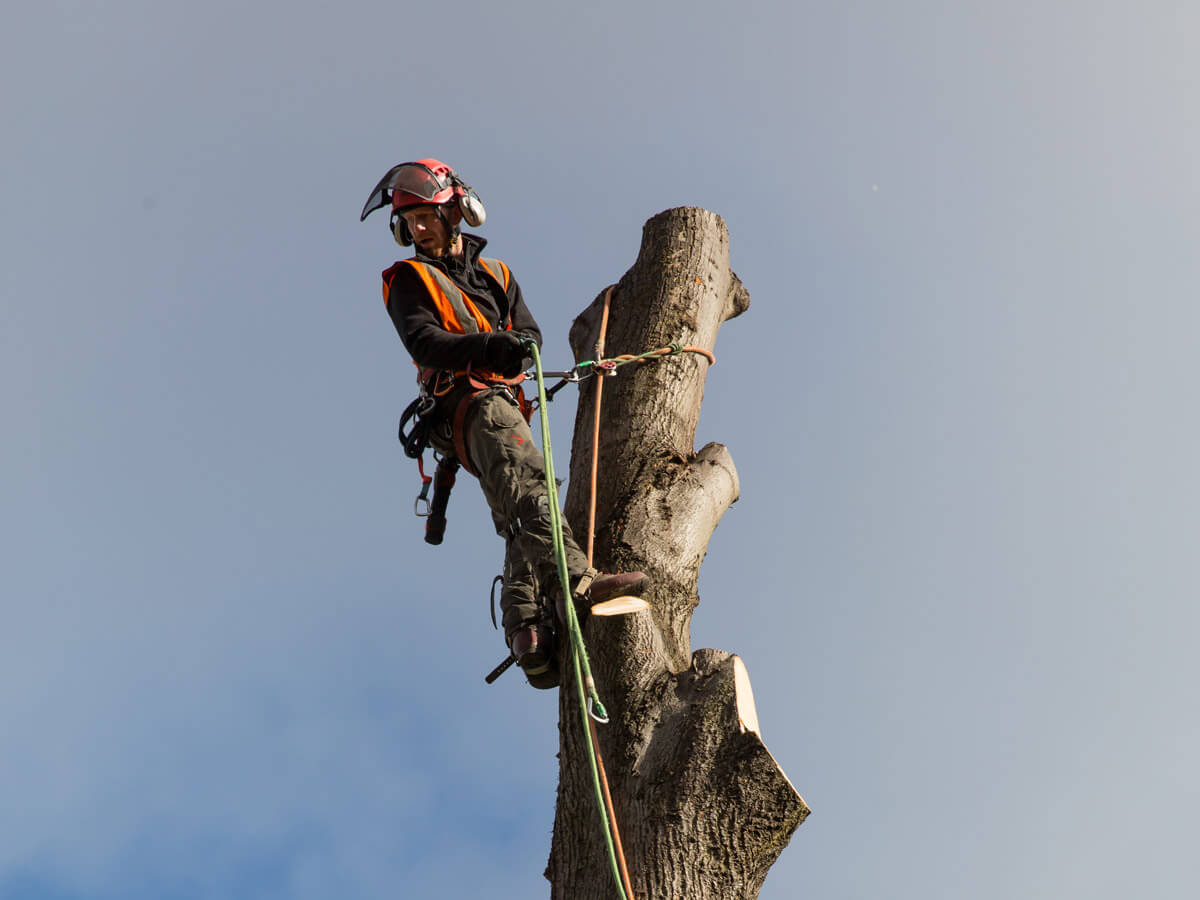
This does not mean that everyone who calls themselves a tree surgeon is unqualified. Many experienced, skilled tree care professionals use the term accurately to describe their work — the physical, hands-on aspects of tree care including pruning, climbing, rigging, and removal. Years of field experience produce real competence, and experienced tree workers without formal certification are often genuinely skilled at the physical work their jobs require.
What it does mean is that the title itself tells you nothing definitive about the person’s training, knowledge, or qualifications. As one arboricultural educator describes it, tree surgeon is a term that can be used by almost any person who works on trees — including people with little or no formal training who have given themselves an impressive-sounding title.
When a company’s only credentials are described as “experienced tree surgeons,” you are working with a qualification that cannot be independently verified.
What an Arborist Is — and What ISA Certification Means
Arborist is also used informally, and not everyone who calls themselves an arborist holds formal credentials. But there is a specific, verifiable certification standard associated with the term: ISA Certified Arborist, awarded by the International Society of Arboriculture.
ISA Certified Arborist is a professional credential with specific, auditable requirements. To sit the certification exam, a candidate must have a minimum of three years of full-time paid experience in arboriculture. The exam itself covers tree biology, soil science and nutrition, pruning and crown management, diagnosis of diseases and pests, tree risk assessment, cabling and bracing systems, tree preservation during construction, and municipal arboriculture. It is a comprehensive assessment of knowledge across the full scope of professional tree care — not just the physical skills of working in a tree.
After earning certification, ISA Certified Arborists must maintain their credentials through ongoing continuing education, earning credits every three years to retain the designation. This continuing education requirement keeps certified arborists current with evolving research, updated pruning standards under ANSI A300, and emerging disease and pest threats — including beech leaf disease, which has expanded significantly in Connecticut since its first detection in 2019.
The ISA maintains a publicly searchable database of certified arborists at isacertified.isa-arbor.com. Any homeowner can verify whether a specific professional holds current ISA certification by searching by name or location. This verifiability is the core of what the certification provides — it is an independently auditable credential, not a claim.
The Practical Difference for Connecticut Homeowners
In practice, the distinction between a tree surgeon and an ISA Certified Arborist matters most in three specific situations.
Tree health diagnosis and disease treatment. Identifying what is wrong with a tree — distinguishing beech leaf disease from environmental stress, recognizing the early symptoms of oak wilt, assessing whether a declining maple has a root problem or a canopy disease — requires knowledge of tree biology and disease pathology that goes significantly beyond physical tree work skills. An ISA Certified Arborist is trained specifically in this diagnostic work. A tree surgeon with no formal credentials may have encountered similar problems through experience, but they have no verifiable knowledge base for what they are recommending.
Tree risk assessment. Determining whether a tree poses an unacceptable risk to people or property — and documenting that assessment in a form that is useful to a property owner, an insurance company, or a municipal authority — requires training in the ISA Tree Risk Assessment Qualification (TRAQ) or equivalent standards. A risk assessment from an uncertified tree surgeon may reflect genuine experience and good judgment, but it cannot be documented to the standard that formal credentials provide. For tree removals that involve potential dispute or liability — neighbor trees, trees on property lines, trees near structures — a certified arborist’s documentation carries significantly more weight.
Pruning quality. The ISA Best Management Practices and ANSI A300 pruning standards define specific cut placements, maximum removal percentages, and technical requirements for different types of pruning. An ISA Certified Arborist is tested on these standards and is professionally accountable to them. A tree surgeon using the same tools but without this training may make cuts that look similar but are made at locations that do not respect the branch collar, do not follow the 25% removal limit for crown thinning, or damage the tree’s wound response in ways that take years to become visible but that have real long-term consequences for tree health.
Why the Terms Get Conflated
The conflation of tree surgeon and arborist in everyday usage has several sources.
In the UK, where tree surgeon is the more common term, the professional regulatory environment is somewhat different — UK tree surgeons are often qualified under NPTC (National Proficiency Tests Council) standards that provide a more defined certification structure than the term carries in the US. American companies that have borrowed the term from UK usage may be using it in the context of a more rigorous qualification framework than an American tree surgeon designation typically implies.
Some tree care companies use both terms deliberately — describing their consulting and diagnostic staff as arborists and their climbing and removal crews as tree surgeons — as a way of distinguishing the knowledge-intensive from the physical-skill-intensive aspects of the work. This division makes internal operational sense, but it can obscure the credential question for homeowners who don’t know to ask specifically about ISA certification for the person making the recommendations.
And some companies simply use whichever term sounds most impressive to the customer they’re speaking with — which, again, is possible because neither term has a regulated definition in most US jurisdictions.
What to Ask When Hiring Tree Care in Connecticut
Given this landscape, the question for Connecticut homeowners is not “are you a tree surgeon or an arborist?” — because either term can be used by either a highly qualified or entirely uncredentialed practitioner. The questions that actually surface the relevant information are:
“Do you hold ISA certification, and can I verify your certification number?” The ISA credential is the most widely respected in the industry and is verifiable through the ISA’s public database. A professional who holds it will provide the number without hesitation. One who doesn’t will often deflect to experience-based claims.
“Who will actually be working on my trees — and are they certified?” Some companies have one certified arborist on staff for sales and consultation, with uncertified crews doing the physical work. This is worth understanding before you hire, particularly for pruning that requires precise cut placement.
“Can you show me your liability insurance and worker’s compensation coverage?” This is not a credential question, but it is an equally important due diligence step. Tree work involves significant risk to workers, to property, and to the homeowner. Any legitimate company will provide proof of current coverage without hesitation.
“Are you following ANSI A300 standards for this work?” For pruning specifically, ANSI A300 is the published industry standard for tree care practices. A professional who knows what ANSI A300 is and can describe how their pruning approach follows it is demonstrating knowledge beyond the surface level. One who has never heard of it is demonstrating the opposite.
The Connecticut Regulatory Context
Connecticut does not currently require a state license for tree care contractors beyond general business registration. Unlike some states that require arborist licensing at the state level, Connecticut’s tree care industry is largely self-regulated through professional credentials — primarily ISA certification and CTAM (Connecticut Tree Protective Association) membership.
This makes the ISA credential more important, not less, as a proxy for competence in Connecticut’s market. In a state with a licensing requirement, the license provides a minimum floor of verified qualification. Without that floor, the ISA credential is the primary independently verifiable indicator of professional standards.
The Connecticut Tree Protective Association (CTPA), the state’s professional organization for the arboriculture industry, maintains a membership list of Connecticut tree care professionals and companies that is a useful secondary reference point alongside ISA certification verification.
How Erick’s Tree Service Approaches This
At Erick’s Tree Service, our ISA-trained arborists are the people who assess your trees, diagnose their condition, plan the work, and oversee its execution. When you contact us for any tree service — whether it is a routine tree trimming and pruning visit, a tree health and disease assessment, a hazardous tree removal, or an arborist consultation — you are working with professionals whose training and knowledge base is verifiable and current.
We have served residential and commercial properties across Connecticut for 35 years, and the foundation of that longevity is the combination of ISA-standard knowledge and field experience that properly qualified arborists bring to every tree they assess and every cut they make.
If you have a tree concern and want to speak with a qualified professional who can give you a clear, evidence-based recommendation, contact Erick’s Tree Service for a free estimate. We’ll assess the tree, explain what we’re seeing and why, and give you a straightforward recommendation based on the tree’s actual condition — not on what would generate the most work.
Erick’s Tree Service — safe, reliable, and professional tree care for residential and commercial properties across Connecticut.