Forestry mulching is a single-pass land clearing method that simultaneously cuts, grinds, and mulches trees, brush, stumps, and vegetation — processing everything in place and leaving behind a layer of wood chip mulch rather than piles of debris to be hauled away. For Connecticut property owners managing overgrown lots, preparing land for development, controlling invasive species, or maintaining trails and access paths, it offers a faster, cleaner, and environmentally sounder approach than the traditional alternatives.
Traditional land clearing typically involves multiple machines, multiple passes, and significant soil disturbance — bulldozers push material into piles, separate grinders process the larger pieces, and trucks haul the debris off site. Forestry mulching condenses all of that into a single piece of equipment and a single operation, reducing cost, timeline, and the ecological disruption of the clearing process. The mulch that results stays on the property, returning organic matter and nutrients to the soil rather than disappearing into a dump or a burn pile.
Understanding how forestry mulching works, what equipment is involved, and what it accomplishes helps Connecticut homeowners and property managers decide whether it is the right approach for their specific situation.
How the Forestry Mulching Process Works
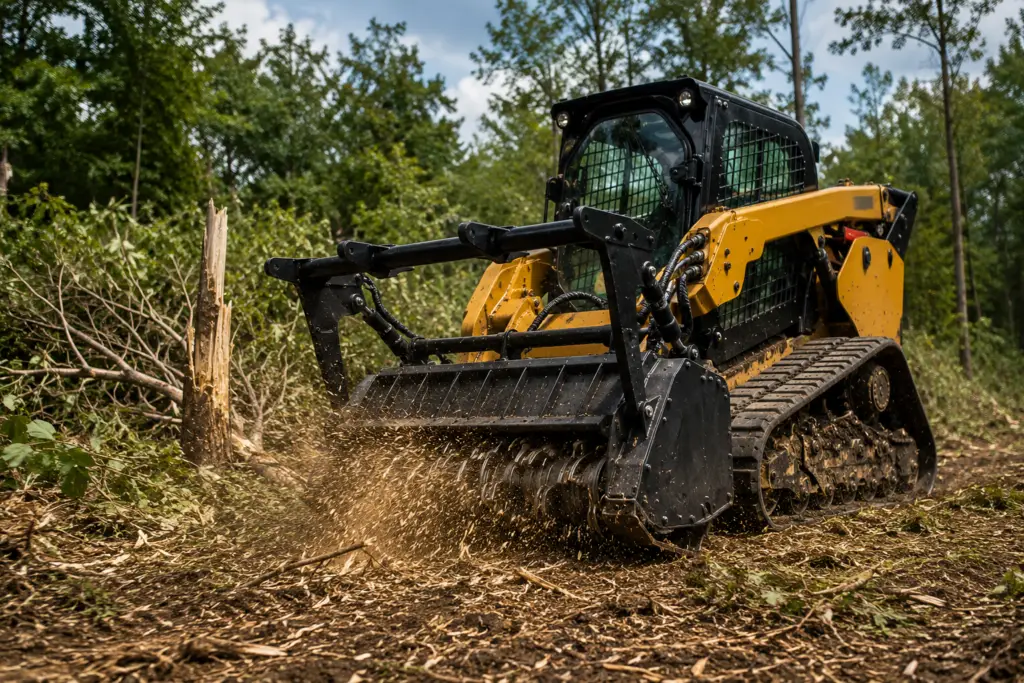
Forestry mulching is straightforward in concept and highly efficient in execution. A purpose-built machine or a carrier equipped with a mulching attachment moves through the vegetation to be cleared. A rotating drum or cutting head mounted at the front of the machine — equipped with hardened steel teeth or carbide-tipped cutting tools — contacts the vegetation and processes it in a single motion: cutting through trunks and branches, grinding the material into chips, and distributing the mulch back onto the cleared ground surface.
The result is a complete clearing of the above-ground vegetation with no piles, no hauling, and no burning. The depth of clearing depends on the size of the trees and the equipment being used. Most forestry mulching setups handle trees up to 6 to 8 inches in diameter efficiently in a single pass. Larger trees — particularly mature hardwoods — are typically felled and removed first, with forestry mulching handling the understory, brush, stumps, and smaller diameter material.
Stumps are processed as part of the same operation. The mulching head grinds through the stump and root flare at or slightly below grade, eliminating the stump without the separate stump grinding step that follows conventional tree removal. This is one of the efficiency advantages of forestry mulching for lot clearing applications — the machine handles trees, stumps, brush, and understory vegetation in a continuous operation without repositioning or changing equipment.
The mulch layer left on the surface is typically 3 to 6 inches deep depending on the density of the cleared vegetation. This layer decomposes over time, enriching the soil with organic matter and nutrients. For properties being prepared for development or construction, the mulch layer is typically left in place during the site preparation phase and either incorporated into grading or removed as part of final site work.
The Environmental Benefits of Forestry Mulching
The environmental advantages of forestry mulching over conventional land clearing methods are substantial and are one of the primary reasons it has grown in adoption among Connecticut property owners and land managers who care about how their land management practices affect the surrounding ecosystem.
Minimal Soil Disturbance
Conventional land clearing with bulldozers and heavy equipment compacts and disturbs the soil to a significant depth, destroying the soil structure, compressing root systems, and eliminating the biological activity that makes healthy soil functional. Forestry mulching equipment operates on the surface — it processes the above-ground vegetation without digging into the soil below. The root system of cleared vegetation remains in the ground, holding soil particles in place and maintaining the existing soil structure. This is a meaningful difference for properties adjacent to wetlands, streams, or slopes where soil disturbance has direct water quality implications.
Connecticut’s environmental regulations — particularly the inland wetlands and watercourses protections administered by local inland wetlands commissions — reflect the importance of minimizing soil disturbance near sensitive areas. Forestry mulching’s surface-only operation makes it compatible with clearing work in and around regulated areas in ways that more disruptive clearing methods are not.
Erosion Control
The mulch layer that forestry mulching leaves behind serves as immediate erosion protection for the cleared area. Bare soil exposed by conventional clearing is highly vulnerable to erosion from Connecticut’s spring rains and summer thunderstorms. The mulch surface absorbs rainfall impact, slows water movement across the soil surface, and holds topsoil in place until the site is stabilized through grading or vegetation establishment. This is particularly relevant for sloped properties, where exposed soil can erode rapidly during wet seasons.
Soil Nutrition and Organic Matter
As the mulch layer decomposes, it releases nutrients back into the soil — nutrients that were contained in the vegetation that was cleared. Conventional clearing removes that material from the site entirely, depleting the organic matter that supports future soil health. Forestry mulching keeps those nutrients on site, improving the biological activity and fertility of the cleared area and supporting the establishment of new vegetation — whether that is lawn, native plantings, or the understory of a managed woodland.
No Burning Required
Burning cleared vegetation is still practiced in some land management contexts, but it carries real costs: air quality impacts from smoke, fire risk during dry conditions, the loss of all organic matter from the site, and in many Connecticut municipalities, permit requirements and burn bans that make open burning impractical. Forestry mulching eliminates the need to burn by processing material into mulch on site, with none of the smoke, air quality concerns, or fire risk that burning involves.
Invasive Species Management
Connecticut’s landscape is significantly affected by invasive plant species — Japanese barberry, multiflora rose, Oriental bittersweet, autumn olive, and others that establish aggressively and crowd out native vegetation. Forestry mulching is an effective first-step tool for invasive species management, clearing dense stands in a single operation and disrupting the above-ground structure of established invasive populations. The mulch layer that results can suppress germination of invasive seeds in the treated area, reducing the rate of re-establishment.
It is important to note that forestry mulching alone does not eliminate invasive species — many will regrow from root systems or re-seed from surrounding areas. A comprehensive management approach combines initial mulching with follow-up monitoring and targeted control. But as a rapid way to set back dense invasive stands and create conditions where native species can be re-established, it is one of the most efficient tools available.
Equipment Types Used in Forestry Mulching
The equipment used for forestry mulching varies based on the scale and terrain of the project. Understanding the main equipment types helps property owners understand what to expect and why different machines are used for different applications.
Dedicated Forestry Mulchers
Dedicated forestry mulching machines are purpose-built carriers — tracked or wheeled — with a mulching head integrated into the machine design. These are the high-production workhorses of the forestry mulching industry, capable of processing significant acreage efficiently and handling trees up to 8 to 12 inches in diameter depending on the model. Their size and production capacity make them most appropriate for larger properties — multi-acre lot clearing, invasive species management across significant land areas, or forest stand management projects.
Tracked dedicated mulchers have a low ground pressure footprint relative to their weight, which reduces soil compaction compared to wheeled heavy equipment. This characteristic makes them particularly suited to Connecticut’s frequently wet spring conditions, where tracked machines can access properties that wheeled equipment would tear up.
Skid-Steer Mounted Mulching Attachments
Skid-steer loaders equipped with forestry mulching attachments are the most common equipment type for residential and smaller commercial forestry mulching applications. The mulching head attaches to the skid-steer’s hydraulic coupler, drawing power from the machine’s hydraulic system to drive the cutting drum. Skid-steers are compact, highly maneuverable, and capable of operating in areas that larger dedicated machines cannot access — between structures, in tight lot configurations, and on sloped terrain where a larger machine would be impractical.
The tradeoff for this maneuverability is production capacity. A skid-steer mulching attachment handles material up to 4 to 6 inches in diameter efficiently, with larger material requiring pre-felling or multiple passes. For residential lot clearing, overgrown brush and small tree management, and access path clearing on Connecticut properties, a skid-steer mounted mulcher is typically the right tool.
Excavator Mounted Mulching Heads
Excavator-mounted mulching heads combine the reach and digging capability of an excavator with a mulching attachment at the end of the boom arm. This configuration is particularly useful for selective clearing — removing specific trees or clearing specific areas while leaving surrounding vegetation intact — and for working on steep slopes where a tracked machine on the ground would struggle with stability. The excavator’s reach allows the operator to process material without positioning the carrier directly adjacent to each tree, which is a significant safety and access advantage in difficult terrain.
Drum vs. Disc Mulching Heads
Within the mulching head category, two primary cutting mechanism designs are common: drum mulchers and disc mulchers.
Drum mulchers use a cylindrical rotating drum equipped with multiple cutting teeth arranged across its surface. The drum rotates at high speed, and the teeth contact and shred the vegetation as the head moves forward. Drum mulchers are the most widely used design in general forestry mulching applications — they handle a wide range of material efficiently, produce a consistent chip size, and are well-suited to the mix of brush and small trees typical of Connecticut land clearing work.
Disc mulchers use a large spinning disc with cutting blades attached at the periphery. They tend to produce finer material than drum mulchers and can handle certain types of vegetation — particularly dense brush and smaller diameter stems — more efficiently. They are less common in general land clearing applications but are used in specialized vegetation management contexts.
Applications for Forestry Mulching in Connecticut
The situations where Connecticut property owners commonly use forestry mulching reflect the state’s specific landscape — heavily wooded residential lots, properties with significant invasive species pressure, waterfront and wetland-adjacent land requiring sensitive management, and vacant land being prepared for development or improved for access and recreational use.
Lot clearing for construction and development is one of the most common applications. A property owner preparing a lot for a home, accessory structure, or site improvement needs the existing vegetation cleared efficiently and the site left in a condition ready for grading and construction. Forestry mulching accomplishes this in fewer machine days than conventional clearing and leaves the soil structure more intact for subsequent grading work.
Overgrown property reclamation is another significant application in Connecticut, where a substantial number of residential properties have sections that have reverted to brush and scrub over years or decades of limited management. Forestry mulching can convert an overgrown, unusable area into a managed, accessible part of the property in a single operation.
Trail and access path creation through wooded areas uses forestry mulching to clear the path corridor, process the cleared material into mulch in place, and create a navigable path with a natural surface — all in one pass.
Invasive species control across larger property areas — particularly for the dense multiflora rose, Japanese barberry, and autumn olive stands that have established across much of Connecticut’s suburban and rural landscape — benefits from forestry mulching’s ability to process large stand areas rapidly and disrupt established root structure.
Erick’s Tree Service offers forestry mulching in Connecticut for residential and commercial properties, combined with related services including land clearing and lot cleaning, brush and debris removal, and stump grinding for properties where conventional stump removal is needed alongside or instead of forestry mulching. Our wood chipping service handles material from tree work on properties where the chipped output is useful on site.
Is Forestry Mulching Right for Your Connecticut Property?
Forestry mulching is the right approach when the goal is efficient clearing with minimal site disruption, when the cleared material should stay on the property as mulch rather than being hauled away, and when the terrain and project scale are compatible with the available equipment.
It is less appropriate for properties where the cleared material needs to be removed entirely — for final site grading, for example, where a clean slate is required rather than a mulch layer. In those situations, conventional clearing with debris removal may be more practical for the final site condition required.
For most Connecticut property owners managing overgrown land, invasive species, or site preparation for development, forestry mulching offers a faster, cleaner, and more ecologically responsible approach than the alternatives — and one that leaves the land in better condition for whatever comes next.
Contact Erick’s Tree Service for a consultation on whether forestry mulching is the right approach for your property, and for a free estimate on any of our land clearing, tree care, or site preparation services across Connecticut.
Erick’s Tree Service — safe, reliable, and professional tree care for residential and commercial properties across Connecticut.