
A tree emergency is any situation where a tree, or part of a tree, poses an immediate and active threat to the safety of people, structures, or utilities — where the risk of serious harm is present right now, not hypothetically at some point in the future. That definition draws a clear line between situations that require a phone call tonight and situations that warrant scheduling an assessment in the coming days or weeks.
Most homeowners, when they notice something concerning about a tree on their property, aren’t sure which side of that line they’re on. Is this an emergency or just a problem? Does this need a same-day response or a routine appointment? The uncertainty is understandable. Trees are large, their failure patterns aren’t always visible, and the consequences of getting the assessment wrong — in either direction — are real.
In Connecticut, where trees are subjected to nor’easters, ice storms, summer microbursts, late-season tropical remnants, and the structural stress of repeated freeze-thaw cycles across a long winter, the conditions that create genuine tree emergencies are not rare. Here is exactly what qualifies, what the warning signs are, and what to do when you encounter them.
Situations That Constitute an Active Tree Emergency
These are the conditions that require immediate professional response — same day, or sooner.
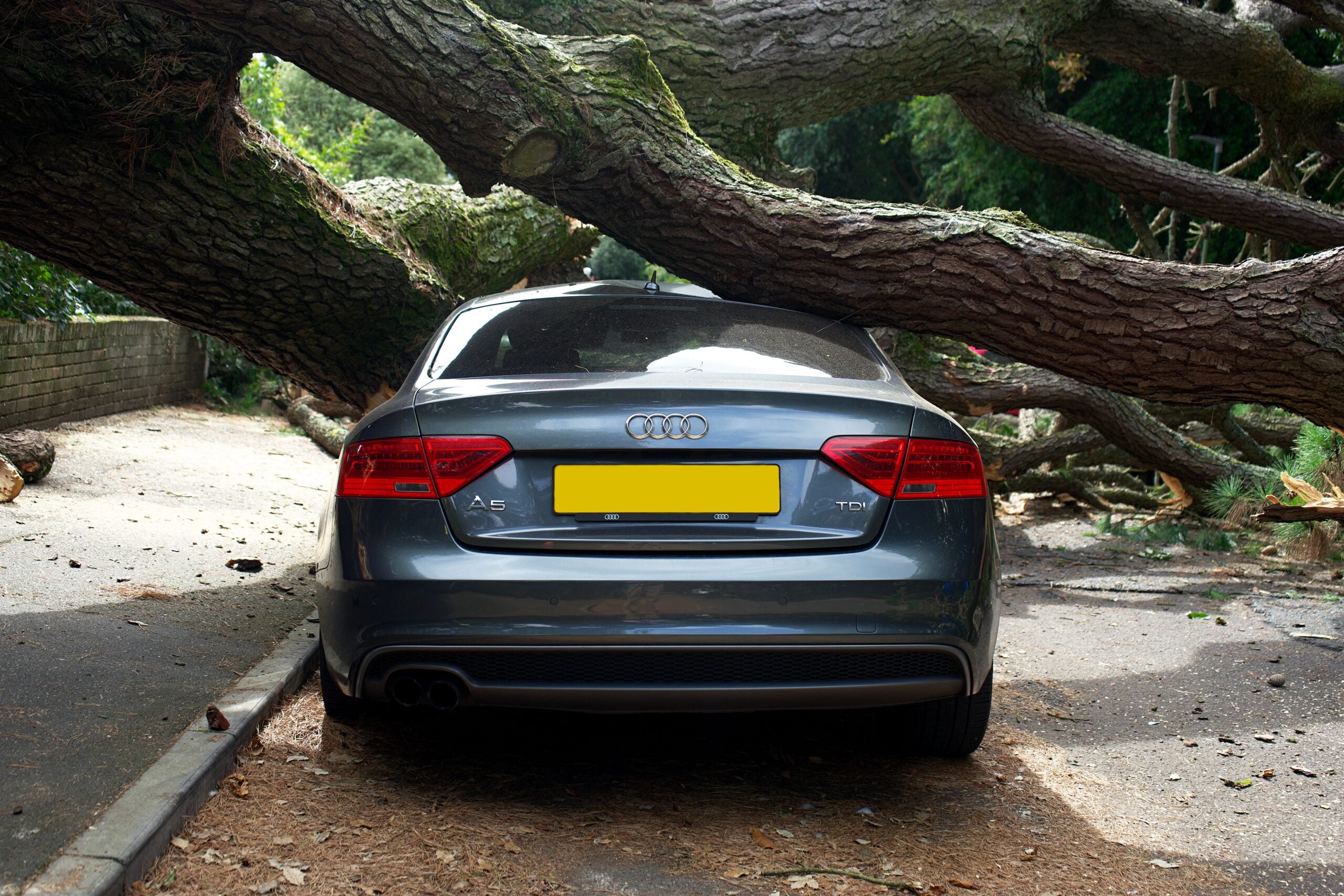
A Tree Has Fallen on a Structure, Vehicle, or Occupied Space
A fallen tree in contact with a home, garage, fence, vehicle, or any occupied or regularly used structure is a tree emergency without exception. The tree may have damaged the structure’s integrity in ways that aren’t immediately visible from the outside. The weight distribution across the fallen trunk creates forces that can cause additional collapse if the tree shifts or if sections are removed without understanding the load. And there is often secondary risk from further material in the canopy that remains partially attached and can drop without warning.
Do not attempt to enter a structure where a tree has made contact until a professional has assessed whether the building is safe. Do not attempt to cut or move any part of the tree yourself. Call a tree service with emergency response capability immediately, and call your insurance company as soon as the immediate safety situation is managed.
A Tree Is Down on Power Lines
A tree or major branch in contact with power lines is a tree emergency that requires two calls: your utility company first, then a tree service. Every wire should be treated as energized until a utility crew confirms otherwise. The ground around a downed wire can be energized. A tree in contact with a live line can transmit current through its trunk to anyone who touches it. Stay well clear — at least thirty feet — and keep others away.
Eversource Energy and United Illuminating both operate 24-hour emergency lines for downed wire reports in Connecticut. Utility crews will de-energize the line before any tree service work can safely begin near it. Responsible tree companies will not work near active power lines regardless of the circumstances.
A Large Tree Is Actively Leaning or Has Shifted Since a Storm
A sudden lean — one that appeared after a storm or that has been visibly progressing over recent days — is a tree emergency if the tree is within striking distance of any structure, vehicle, walkway, road, or area where people regularly spend time. A new lean is fundamentally different from a tree that has always grown at an angle. A long-standing lean reflects compensating wood structure and root development. A new lean, particularly one that appeared during or after a weather event, typically indicates that the root system has been compromised or that the structural integrity of the trunk has failed in a way that is not yet visible on the outside.
Look for these additional signs that make a leaning tree an active emergency: soil mounding or cracking at the base of the tree on the opposite side from the lean, indicating root lift; exposed roots on the tension side; or a lean that is visibly worsening over hours or days. Any combination of new lean with these signs in a tree positioned to strike a target warrants a same-day professional response.
A Widow Maker Is Hanging in the Canopy
A widow maker is a dead, broken, or partially detached branch that is hanging in the canopy — held in place by other branches or by a partial attachment to the trunk — and can drop without warning at any time, in any weather, including calm conditions. The name reflects exactly the level of hazard involved.
Widow makers are a tree emergency when they are large enough to cause injury or property damage and when they are positioned over a target: a home, a driveway, a walkway, a play area, a patio, or any regularly occupied outdoor space. Dead branches over four inches in diameter hanging over a target are serious hazards. Hung branches that resulted from storm damage — material that broke and lodged in the canopy rather than falling cleanly — should always be treated as an active emergency because their behavior when they do release is entirely unpredictable.
Do not stand under or near a widow maker. Do not attempt to knock it down yourself. Call a professional for immediate removal.
A Tree Has Cracked or Split at the Trunk or a Major Union
Deep, fresh cracks in a tree’s trunk or at the union where a major branch meets the trunk indicate that structural failure has already begun. The ISA’s tree risk assessment framework identifies cracks as one of seven high-risk defects, particularly when they are co-dominant with other warning signs — decay, included bark, or a narrow V-shaped branch union rather than a healthy U-shaped one.
A split trunk or co-dominant stem that has begun to separate under load is a tree emergency when it is positioned to strike a target. The failure of a co-dominant stem under wind load or snow weight is one of the most sudden and violent forms of tree failure — the two stems act as a lever, and the split propagates rapidly once it begins. There is typically very little warning between the crack that can be observed and the failure that follows.
Situations That Are Urgent But Not Active Emergencies
These situations require professional attention soon — within days, not weeks — but do not require a middle-of-the-night call.
A tree is dead or severely declining. A dead tree doesn’t fall on a schedule, but it does become progressively more likely to fail as wood dries out, root anchoring deteriorates, and the structural integrity of the canopy degrades. A dead tree within striking distance of a structure or regularly used area should be assessed and scheduled for removal promptly — before the next significant wind event makes the decision for you. This is urgent, not emergency.
Fungal conks or mushrooms at the base of the trunk. Shelf fungi, conks, or mushrooms growing on the trunk or at the root flare are external signs of significant internal decay. By the time the fruiting body is visible on the outside, the fungus has colonized a substantial volume of wood inside the tree. This does not mean the tree is about to fall today — it means the tree’s structural integrity is compromised and needs professional evaluation before the next storm season.
Significant storm damage that didn’t create an immediate fall. A tree that sustained major branch losses, crown breakage, or root disturbance in a storm but is still standing needs a structural assessment within a few days. What looks stable may not be — and the stress of further weather on an already-damaged structure can produce failure that a timely assessment and intervention would have prevented.
Bark damage, cankers, or significant crown dieback. These are signs of disease or structural problems that may be progressing toward failure, but they don’t constitute an active emergency unless they are combined with other high-risk indicators or are positioned over a target at a stage where failure appears imminent.
The Seven High-Risk Tree Defects Connecticut Homeowners Should Know
The ISA’s tree risk assessment framework identifies seven structural defects that, alone or in combination, create elevated failure risk. Understanding these helps homeowners distinguish between a tree that looks concerning and one that represents a genuine hazard.
Dead wood — dead branches or a dead tree. Cannot bend under wind load the way living wood can. Falls without warning.
Cracks — deep splits in the trunk or major branches that indicate structural failure has begun. Most serious when combined with decay.
Weak branch unions — narrow V-shaped unions with included bark between two stems, where bark is trapped between the two leaders rather than forming a strong wood-to-wood connection. The most common failure point in storm-related branch losses.
Decay — internal rot that removes structural wood from the trunk or major branches. Visible externally through soft or punky wood, cavities, or fungal growth. The amount of remaining sound wood determines residual structural capacity.
Cankers — localized areas of dead bark caused by fungal or bacterial pathogens. Can girdle stems and create structural weak points above the canker.
Root problems — root damage from construction, soil compaction, disease, or physical injury that reduces the tree’s anchoring capacity. Often the reason a tree fails in a storm even when the above-ground structure appears sound.
Poor tree form — imbalanced crown, excessive lean, or structural patterns that concentrate load in ways that create elevated failure risk under wind.
A tree with one of these defects and a significant target in its failure zone warrants professional assessment. A tree with multiple defects in combination warrants urgent attention. A tree with multiple defects showing recent change — a crack that is widening, a lean that has increased, fungal growth that appeared recently — warrants treating the situation as an active tree emergency.
What Separates a Tree Emergency From Routine Tree Care
The practical answer is immediacy and target. A tree is an emergency when it is failing right now — actively, not hypothetically — and when its failure path includes people, structures, or utilities.
A dead tree in a back corner of a wooded property with nothing within its fall radius is not a tree emergency. A dead tree leaning over a driveway where cars park is. A tree with a fungal canker in the middle of its trunk is a concern that warrants assessment. A tree with that same canker that has visibly cracked at the canker site and is positioned to strike the roof is an active tree emergency.
The variable that turns a tree problem into a tree emergency is the presence of a target — and the likelihood of imminent failure. When both are present, the response should be immediate.
When to Call Erick’s Tree Service for a Tree Emergency in Connecticut
Erick’s Tree Service provides emergency tree removal for active tree emergency situations across Connecticut — fallen trees on structures, hanging widow makers, split trunks, and any situation where a tree poses an immediate threat to safety or property. We also provide hazardous tree removal for situations that are urgent but not yet active emergencies, and storm damage tree cleanup following weather events that leave material in the canopy or on the ground.
For homeowners who aren’t sure whether what they’re seeing constitutes an emergency, our arborist consultation service provides a professional assessment that answers that question with a qualified eye on the actual tree — not a guess from a description. Our storm preparation tree assessment identifies the trees most likely to produce an emergency before a storm creates one, giving homeowners the ability to act on their schedule rather than in crisis mode.
If you have a tree that you believe may be a tree emergency, do not wait to find out. Contact Erick’s Tree Service for an immediate response. We provide fallen tree removal and emergency service for residential and commercial properties across Connecticut and have been doing so for 35 years.
Erick’s Tree Service — safe, reliable, and professi