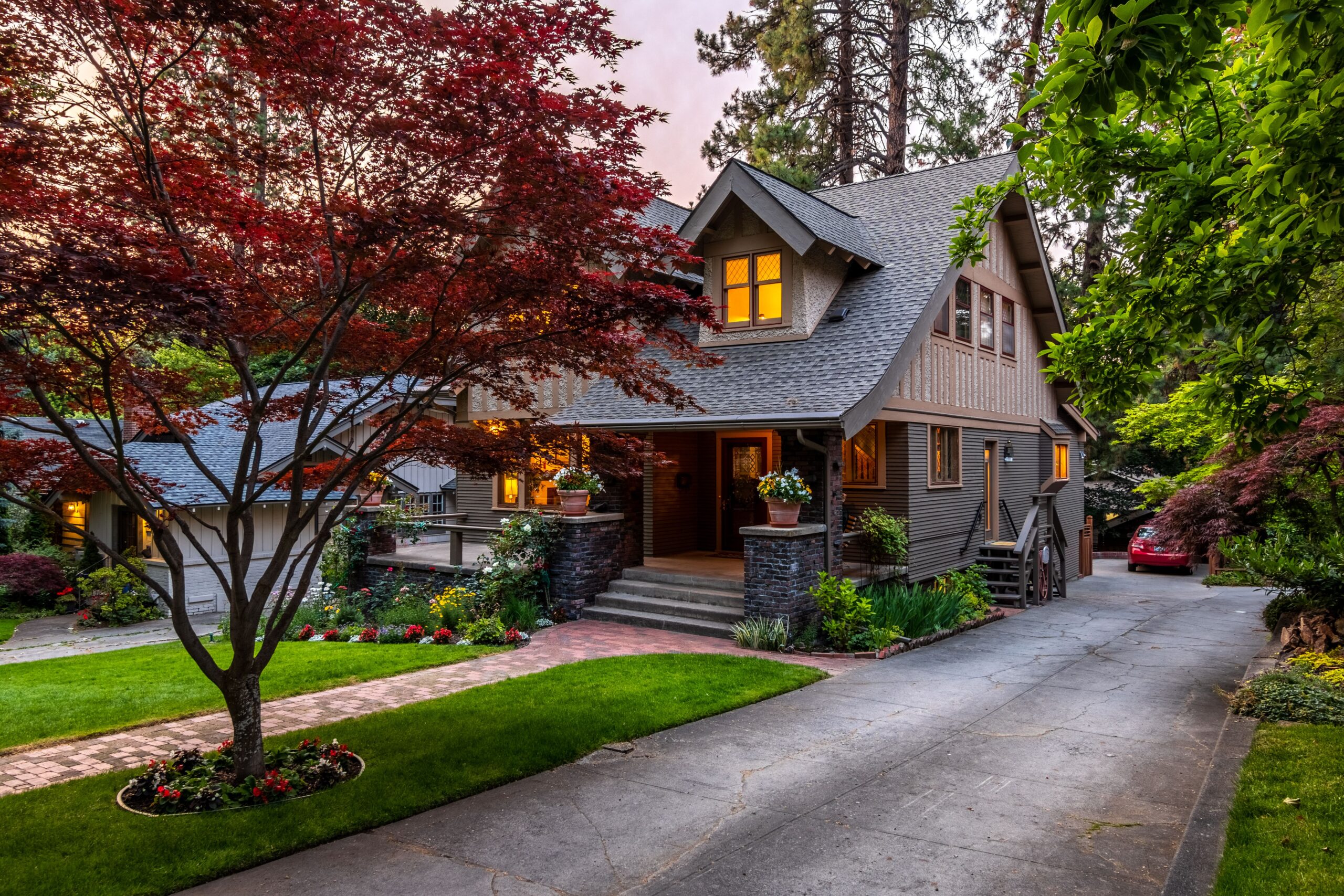
Trees increase property value in measurable, documented ways — and Connecticut homeowners are in a strong position to benefit. Studies from the USDA Forest Service and the Arbor Day Foundation consistently show that mature, well-maintained trees add between 7% and 19% to residential property values depending on species, size, placement, and condition. On a $500,000 home — close to Connecticut’s median — that represents $35,000 to $95,000 in added value. No other landscaping investment comes close to those numbers.
The key word in all of that is maintained. A neglected tree with deadwood overhanging the roof, visible decay at the base, or a canopy that has not been touched in a decade does not add value. It reduces it. Understanding how trees increase property value — and what conditions determine whether a tree is an asset or a liability — is essential for any Connecticut homeowner who wants to make the most of their landscape.
1. Trees Increase Property Value Through Curb Appeal and First Impressions
Real estate professionals consistently identify curb appeal as one of the most influential factors in how quickly a home sells and at what price. A mature tree in the front yard — properly pruned, structurally sound, and positioned to frame the home — creates an immediate visual impression that no other landscaping element can replicate.
Research published by the University of Washington found that street trees alone increase the perceived value of nearby homes, with buyers willing to pay a premium simply for the presence of mature trees in the neighborhood. On the property itself, a well-placed specimen tree at the front of the lot signals to buyers that the property has been cared for over time — a subtext that carries weight throughout the entire showing.
Maintaining that impression requires regular care. Tree trimming and pruning keeps the canopy shaped, removes deadwood that reads as neglect, and ensures the tree is structurally sound — all of which translate directly to how the property photographs and presents in person.
2. Mature Shade Trees Reduce Energy Costs — and Buyers Know It
Strategic tree placement reduces residential energy costs in both summer and winter. The USDA Forest Service estimates that three well-placed shade trees can reduce air conditioning costs by up to 30% annually. In Connecticut, where summer temperatures regularly push into the 90s and cooling costs climb through July and August, that is a meaningful number.
Deciduous trees planted on the south and west sides of a home shade the roof and walls during summer while allowing winter sun through after leaf drop — a passive energy benefit that requires no systems, no maintenance contracts, and no utility upgrades. Buyers who understand energy efficiency recognize and price this into their offers.
The trees most effective for this purpose in Connecticut are large-canopy deciduous species: red maple, sugar maple, white oak, and tulip poplar all deliver substantial shade coverage at maturity. Deep root fertilization supports the long-term health of these canopy trees, ensuring they maintain the density and vigor that makes them effective energy buffers.
3. Trees Increase Property Value by Creating Usable Outdoor Living Space
The relationship between mature trees and outdoor living space is direct: shade makes outdoor areas usable in Connecticut’s summer heat in a way that no pergola, awning, or structure can fully replicate. A shaded backyard patio, a canopied lawn, or a tree-lined garden creates functional outdoor space that buyers increasingly treat as an extension of the home’s square footage.
This matters in Connecticut’s current real estate market, where outdoor space has become a significant selling point following the shift toward remote work and increased time spent at home. Properties with mature trees that create defined, comfortable outdoor environments consistently command premiums over comparable properties without them.
The condition of those trees matters as much as their presence. A professional arborist consultation before listing a property can identify which trees are genuine assets, which need maintenance to reach their potential, and whether any represent liabilities that should be addressed before buyers see the property.
4. Well-Maintained Trees Signal Responsible Long-Term Ownership
This is a subtler mechanism, but it consistently influences buyer perception and offer prices: mature, well-cared-for trees signal that a property has been responsibly maintained over time. Trees do not become assets overnight. A 40-year-old oak or a 30-year-old maple represents decades of growth, care, and investment — and buyers understand that implicitly.
Conversely, trees in poor condition send the opposite signal. A canopy full of deadwood, a trunk with visible decay, or a tree that has clearly not been pruned in years raises questions about what else on the property may have been deferred. In pre-sale inspections, problem trees are increasingly flagged alongside roof condition, HVAC age, and foundation issues.
Addressing tree health before listing is a straightforward way to remove those concerns from a buyer’s checklist. A tree health and disease assessment documents the condition of your trees and identifies any issues that need attention before they become negotiating points.
5. Privacy Trees and Screening Add Value That Buyers Will Pay For
Privacy is among the most consistently cited priorities of Connecticut homebuyers, particularly in suburban neighborhoods where lot sizes have decreased and homes sit closer together. Mature screening trees — white pine, arborvitae, hemlock — create visual buffers that no fence can replicate at scale, and they increase perceived property value by making outdoor spaces feel genuinely private and contained.
Properties with established screening along property lines or between the yard and a road command premiums that frequently exceed what a standard privacy fence would add. The difference is permanence and scale: a 40-foot stand of white pine is something a buyer cannot replicate for years, whereas a fence can be installed in a week.
If screening trees on your property have gaps, are in decline, or need replacement, professional tree planting services can assess the site and select species suited to Connecticut’s climate and your specific soil conditions. Eastern white pine, American arborvitae, and Canadian hemlock are the three most reliable screening choices for Connecticut properties.
6. Trees Increase Property Value by Reducing Stormwater and Erosion Risk
This is a property value mechanism that fewer homeowners think about, but it carries real weight in Connecticut — particularly in areas with sloped terrain, clay soils, or properties near water. Mature trees intercept significant volumes of rainfall through their canopies and root systems, reducing surface runoff, controlling erosion on slopes, and buffering properties from the flooding and soil loss that increasingly affect Connecticut neighborhoods during heavy rain events.
Properties with mature tree cover on slopes or near drainage areas are demonstrably more stable than cleared lots. Buyers and their inspectors notice the difference, and in areas where stormwater management is a known issue, tree cover can be a deciding factor.
Forestry mulching and land clearing services can help manage overgrown areas while retaining the trees that provide genuine stormwater and erosion protection — preserving the value those trees represent rather than eliminating it.
7. Removing Problem Trees Also Increases Property Value
This point is counterintuitive but important: strategically removing a problem tree can increase property value just as reliably as maintaining a healthy one. A dead, diseased, or structurally compromised tree overhanging a home is a documented liability. It depresses sale prices, triggers negotiation in buyer inspections, and in some cases prevents financing from closing until the hazard is resolved.
Dead trees are the clearest case. A standing dead tree adjacent to a structure has no landscape value and carries significant risk. Dead tree removal eliminates that liability cleanly. The same logic applies to trees with advanced structural defects, severe disease, or placement that creates chronic problems for foundations, driveways, or utility lines.
Hazardous tree removal is not a loss of landscape value — it is the removal of a liability and the opening of space for a replacement planting that will add value on a positive trajectory rather than a declining one.
What Tree Condition Actually Does to Appraisals
Professional appraisers in Connecticut increasingly incorporate tree condition into their assessments. The Trunk Formula Method — endorsed by the ISA (International Society of Arboriculture) — provides a structured framework for calculating the contributory value of individual trees based on species, size, condition, and location. A 24-inch diameter red maple in excellent condition on a well-maintained property can have an appraised contributory value exceeding $10,000 using this methodology.
Condition is the variable that homeowners control. Species and size are largely fixed once a tree is established, but condition — structural integrity, canopy health, disease status, maintenance history — is directly managed through professional tree care.
The Pre-Sale Tree Care Checklist
If you are planning to sell in the next one to three years, these are the tree care priorities that most directly affect how buyers and appraisers perceive your landscape:
- Remove all deadwood from canopies overhanging the home, driveway, and outdoor living areas
- Address any visible trunk damage or decay — open wounds and cavity rot are red flags for buyers and inspectors
- Prune for structure and clearance — canopy lifted off the roof, limbs cleared from the house, and a well-shaped overall form
- Remove dead or severely declining trees before they become emergency removals
- Replace removed trees with appropriate species planted at the correct grade and with professional establishment care
- Document maintenance — records of arborist visits, pruning, and treatments add credibility to your claim that the landscape has been professionally managed
How Much Does Tree Care Cost Relative to What It Returns
Professional tree pruning for a mature shade tree in Connecticut typically runs $300–$800 depending on size and complexity. Stump grinding after a removal runs $150–$400 per stump. A full arborist consultation covering the entire property costs $200–$500. Against the $35,000–$95,000 range that mature, well-maintained trees can add to a Connecticut home’s value, the maintenance costs are modest. Against the negotiating leverage a problem tree gives a buyer, the cost of addressing it beforehand is negligible.
The math is straightforward: the trees on your property are either working for you or against you. Professional maintenance determines which.
Whether you are preparing to list your property, planning a long-term landscaping investment, or simply trying to understand what your trees are worth, Erick’s Tree Service can help. Our certified arborists assess tree condition, structure, and health across residential and commercial properties throughout Connecticut — and we can tell you exactly which trees are adding value and which ones need attention.
Contact Erick’s Tree Service to schedule your free property assessment, or learn more about our full range of tree care and removal services.
Erick’s Tree Service — safe, reliable, and professional tree care for residential and commercial properties across Connecticut.